From Wikipedia, the free encyclopedia
For other uses of Sephirot or Sephira, see Sephirot (disambiguation) Sephirot (In Hebrew סְפִירוֹת, pronunciation), meaning "enumerations", are the 10 attributes/emanations in Kabbalah, through which God (who is referred to as Ein Sof - The Infinite) reveals himself and continuously creates both the physical realm and the chain of higher metaphysical realms (Seder hishtalshelus). The term is alternatively transliterated into English as Sephiroth/Sefiroth, singular Sephirah etc.
Alternative configurations of the sephirot are given by different schools in the historical development of Kabbalah, with each articulating different spiritual aspects. The tradition of enumerating 10 is stated in the Sefer Yetzirah, "Ten sephirot of nothingness, ten and not nine, ten and not eleven". As altogether 11 sephirot are listed across the different schemes, two (Keter and Daat) are seen as unconscious and conscious manifestations of the same principle, conserving the ten categories. In Kabbalah the functional structure of the sephirot in channelling Divine creative lifeforce, and revealing the unknowable Divine essence to Creation is described. As God's attributes to allow Creation to know him, the first sephirah describes the Divine Will above intellect. The next sephirot describe conscious Divine Intellect, and the latter sephirot describe the primary and secondary conscious Divine Emotions. Two sephirot (Binah and Malchut) are feminine, as the female principle in Kabbalah describes a vessel that receives the outward male light, then inwardly nurtures and gives birth to lower sephirot. Corresponding to this is the Female Divine Presence (Shechinah). Kabbalah sees the human soul as mirroring the Divine (after Genesis 1:27, "God created man in His own image, in the image of God He created him, male and female He created them"), and more widely, all creations as reflections of their lifesource in the sephirot. Therefore, the sephirot also describe the spiritual life of man, and constitute the conceptual paradigm in Kabbalah for understanding everything. This relationship between the soul of man and the Divine, gives Kabbalah one of its two central metaphors in describing Divinity, alongside the other Ohr (light) metaphor. However, Kabbalah repeatedly stresses the need to avoid all corporeal interpretation. Through this, the sephirot are related to the structure of the body and are reformed into Partsufim (Personas). Underlying the structural purpose of each sephirah is a hidden motivational force which is understood best by comparison with a corresponding psychological state in human spiritual experience. In Hasidic philosophy, which has sought to internalise the experience of Jewish mysticism into daily inspiration (dveikus), this inner life of the sephirot is explored, and the role they play in man's service of God in this world.
[edit] Ten Sephirot
The "Sefirot" (סְפִירוֹת), singular "Sefirah" (סְפִירָה), literally means "counting"/"enumeration", but early Kabbalists presented a number of other etymological possibilities from the same Hebrew root including: sefer (text), sippur (recounting a story), sappir (sapphire, brilliance, luminary), separ (boundary), and safra (scribe). The term sefirah thus has complex connotations within Kabbalah.[1]
The Sephirot are considered revelations of the Creator's Will ("ratzon"),[2] and they should not be understood as ten different "gods" but as ten different ways the one God reveals his Will through the Emanations. While in Cordoveran Kabbalah, Keter (The Divine Will) is listed as the first Sephirah, it is an intermediary above consciousness between God and the other, conscious Sephirot. The Sephirot are emanated from the Divine Will, because Kabbalah sees different levels within Keter, reflecting God's inner Will and outer Will. The innermost, hidden levels of Keter, also in some contexts called "The head/beginning that is not known",[3] are united above the Sephirot with the Ein Sof (Divine essence). It is not God who changes but the ability to perceive God that changes. This difference between the "Ma'Ohr" ("Luminary"-Divine essence) and the "Ohr" ("Light") He emanates is stressed in Kabbalah, so as to avoid heretical notions of any plurality in the Godhead. In its early 12th-century dissemination, Kabbalah received criticism from some Rabbis, who adhered to "Hakirah" (Medieval Jewish philosophy), for its alleged introduction of multiplicity into Jewish monotheism. The multiplicity of revealed emanations only applies from the persective of the Creation, and not from the perspective of the infinite Divine essence.[4]
[edit] Listings
The ten Sephirot are a step-by-step process illuminating the Divine plan as it unfolds itself in Creation. They are fully found in the Medieval Kabbalah texts, such as the central work in Kabbalah, the Zohar. The Hebrew etymology of their names in Kabbalah is understood to refer to the nuanced aspects of meaning of each Sephirah. This direct connection between spiritual and physical creations and their Hebrew names, reflects the theology in Kabbalah that Creation is formed from the metaphorical speech of God, as in the first chapter of Genesis. Kabbalah expounds on the terms of the Sephirot. In the first complete systemisation of Kabbalah, in the 16th-century rational synthesis of Moshe Cordovero (Cordoveran Kabbalah), the Sephirot are listed from highest to lowest:[5]
| Category: | Sephirah: |
|---|
| Above-consciousness | 1 Keter-"Crown" |
| Conscious intellect | 2 Chokhmah-"Wisdom" 3 Binah-"Understanding" |
| Conscious emotions | (Primary emotions:) 4 Chesed-"Kindness"
5 Gevurah-"Severity"
6 Tiferet-"Beauty"
(Secondary emotions:)
7 Netzach-"Eternity"
8 Hod-"Splendor"
9 Yesod-"Foundation"
(Vessel to bring action:)
10 Malkuth-"Kingship" |
In the subsequent 16th-century transcendent Kabbalistic scheme of Isaac Luria (Lurianic Kabbalah), the Sephirot are usually listed slightly differently, by taking out Keter and adding in Daat, as Daat is seen as the conscious manifestation of the unconscious Keter. This difference of opinion reflects earlier Medieval debate on whether Keter can be identified with the Ohr Ein Sof (Infinite light) itself, or as the first revealed Sephirah. Isaac Luria includes Keter in the list only in relation to the inner light of the Sephirot. In his usual list of the Sephirot as formed attributes (vessels), Keter is considered too lofty to include:[6]
| Category: | Sephirah: |
|---|
| Conscious intellect | 1 Chokhmah-"Wisdom" 2 Binah-"Understanding"
3 Daat-"Knowledge" |
| Conscious emotions | (Primary emotions:) 4 Chesed-"Kindness"
5 Gevurah-"Severity"
6 Tiferet-"Beauty"
(Secondary emotions:)
7 Netzach-"Eternity"
8 Hod-"Glory"
9 Yesod-"Foundation"
(Vessel to bring action:)
10 Malkuth-"Kingship" |
[edit] Description
- Keter-"Crown": Divine Will to create/Infinite Light of the Creator/the Hebrew name of God "Ehyeh Asher Ehyeh-I am That I am"
- Chochmah-"Wisdom": First unbounded flash of an idea before it takes on limitations/male light/Divine Reality/first revelation/creation from nothingness
- Binah-"Understanding": the infinite flash of Chochmah brought into the vessel of understanding to give it grasp of breadth and depth/feminine vessel that gives birth to the emotions/reason/understanding brings teshuva return to God
- Daat is a central state of unity of the 10 Sephirot, also called the Tree of Life.
- Chesed-"Kindness": Loving grace of free giving/love of God/inspiring vision
- Gevurah-"Severity": Strength/judgment/intention/withholding/awe of God
- Tiferet-"Beauty": Symmetry/balance between Chesed and Gevurah in compassion
- Netzach-"Eternity"
- Hod-"Glory": Withdrawal/Surrender/sincerity
- Yesod-"Foundation": Connecting to the task to accomplish/wholly remembering/coherent knowledge
- Malchut-"Kingship": Female vessel for the pregnant nurturing of the male lights of the emotional sephirot into action/becomes the Keter Will source for any subsequent lower level in Creation/accomplishment/realization of the Divine Plan.
[edit] Two configurations for describing the Sephirot: Iggulim-Circles and Yosher-Upright
Two alternative spiritual arrangements for describing the Sephirot are given, metaphorically described as "Circles" and "Upright". Their origins come from Medieval Kabbalah and the Zohar. In later, 16th-century Lurianic kabbalah, they become systemised as two successive stages in the evolution of the Sephirot, during the primordial cosmic evolution of Creation. This evolution is central to the metaphysical process of tikkun (fixing) in the doctrines of Issac Luria.
[edit] Iggulim-Circles

Metaphorical representation of the
Five Worlds, with the 10 Sephirot radiating in each, as successively smaller
Iggulim-concentric circles
One diagramatic representation depicts the Sephirot metaphorically as successively smaller concentric circles, radiating inwards from the surrounding Divine Omnipresence. The Four Worlds of the Seder hishtalshelus ("Chain of Progression"), or with the addition of the highest Fifth World (Adam Kadmon), can be depicted in this diagram, starting with the highest and proceeding towards the centre of the circle to our lowest, physical realm. In each World the 10 Sephirot radiate, as 10 successive steps in the downward chain of flow towards the next, lower realm. This depiction shows the successive nature of each of the 10 Sephirot, as a downward chain, each more removed from Divine consciousness.
The surrounding space in the diagram is the Infinite Divine reality (Ein Sof). The outermost circle in the teachings of Lurianic kabbalah is the "space" made by the Tzimtzum in which Creation unfolds. Each successive World is progressively further removed from Divine revelation, a metaphorically smaller, more costricted circle. Emanation in each World proceeds down the 10 Sephirot, with the last Sephirah (Malchut-Actualisation of the Divine plan) of one World becoming, and being shared as, the first Sephirah (Keter-The Divine Will) of the next, lower realm. The vertical line into the centre of the circle represents the path of downward emanation and constriction, from the initial first Ohr (light) of the "Kav" (Ray) in Lurianic doctrine.
[edit] Yosher-Upright and the Man-metaphor in Kabbalah
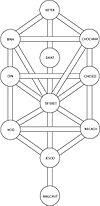
The
Yosher-Upright configuration of the 10 Sephirot, arranged into 3 columns
The most important and well known scheme of depicting the Sephirot arranges them as a tree with 3 columns. The Right column represents the spiritual force of expansion. The Left represents its opposite, restriction. The Middle column is the balance and synthesis between these opposing tendencies. The connecting lines in the diagram show the specific connections of spiritual flow between the Sephirot, the "22 Connecting Paths", and corresponding to the spiritual channels of the 22 letters of the Hebrew alphabet. Kabbalah sees the Hebrew letters as channels of spiritual lifeforce. This derives from the account in Genesis of the Creation of the World, where Creation takes place through 10 Hebrew "Sayings" of God ("Let there be.."). In Kabbalistic theology, these letters remain the immanent spiritual forces that constantly recreate all existence. The paths divide into 3 Categories, shown in this diagram by their different colours, corresponding to the 3 types of letter.
[edit] Evolution of the Sephirot in Lurianic kabbalah from Iggulim to Yosher
Lurianic Kabbalah described radical new doctrines of the cosmic origins of Creation. It taught that the first Divine act was a "withdrawal" ("Tzimtzum") from the "space" ("Chalal") in which Creation would unfold. This is understood by all interpretations today to be a metaphorical withdrawal, only from the persective of the Creation. A diminished "Ray" ("Kav") of new light then shone from the Ein Sof into the Chalal, which became the source of "light" (Ohr) that created all existence.
However, Isaac Luria taught that the first created spiritual "World/Realm" ("Olam") collapsed. This realm, the "World of Tohu" ("Chaos", mirroring the phrase at the beginning of Genesis), failed because the 10 Sephirot in it had very high lights and weak vessels (see Ohr for description of the lights and vessels of the Sephirot). The vessels broke ("Shevirat HaKeilim"-"The Shattering of the Vessels") and their "Sparks" ("Nitzutzot") fell down into our Four Worlds. The four realms of our cosmic existence are together called the "World of Tikkun" ("Fixing"-see Tikkun). Lurianic Kabbalah explains that the reason for the catastrophe was because the 10 Sephirot in the World of Tohu remained separate points of spiritual force. Chesed (Loving-kindness) remained Chesed. Gevurah (Severity) remained its opposite force of restriction, and the Sephirot did not unite together. In the new cosmic existence of Tikkun, the Sephirot evolve into new paradigmatic arrangements, where they can unite together. The different realms (see Seder Hishtalshelut) of the World of Tikkun are characterised as lower lights and stronger vessels.
[edit] Latent interinclusion of the Sephirot
The first development that enabled the Sephirot to unite in cooperation was the interinclusion within each of them of a further subset of the 10 Sephirot. So, for example, Chesed contains Chesed within Chesed, Gevurah within Chesed (typified by a restriction performed out of love, like a father punishing a child) etc. In Kabbalistic interpretation, as there are 7 emotional Sephirot, their subsets form 7x7=49 emotional states. This gives the Kabbalistic interpretation of the mitzvah (Jewish observance) of Counting of the Omer, to count the 49 days of personal spiritual development between the festivals of Passover and Shavuot. Passover commemorates the exodus from Egypt, and in Jewish mystical thought, Egypt (in Hebrew "Mitzrayim", meaning "Limitations") represents the challenges to leave behind in spiritual development. In Kabbalah and Hasidism, leaving Egypt becomes a daily spiritual exodus, especially in the 49 days of preparation to reach Shavuot, commemorating receiving the Torah on Biblical Mount Sinai. Kabbalah teaches the benefit of focusing on the aspect of each Sephirah related to the particular day of the Omer. A person would examine each of their spiritual qualitities, as a rectification process of Teshuva (Return to God)), in preparation to reliving the acceptance of the Torah.
[edit] Reconfiguration of the Sephirot as full Partsufim-Personas
Subsequent to the interinclusion of the 10 Sephirot within each other, in Lurianic Kabbalah they then develop into "Partsufim" ("Personas"). Wide discussion of the Partsufim is found in the Medieval Kabbalah of the Zohar, before Issac Luria. In the Zohar, Shimon bar Yochai expounds upon the spiritual roles of the Parsufim, by talking about them as independent spiritual manifestations. "The Holy Ancient of Days", or "The Long Visage", two of the different Parsufim, are not just alternative adjectives for God, but are particular spiritual manifestations, levels and natures. Lurianic Kabbalah focused on the role of the Parsufim as the fully evolved stage of the primordial evolution of the Sephirot, in the beginning of Creation. Instead of each of the 10 Sephirot merely including a full subset of 10 Sephirot as latent potential forces, the first stage of their evolution, in the Parsufim the Sephirot become fully autonomous and interrelated. The name of each Partsuf denotes that the Sephirah from which it derived, has now become an independent scheme of 10 fully functioning Sephirot in the "Upright" (Yosher) form of "Man". This reconfiguration is essential in Lurianic Kabbalah to enable the opposing spiritual forces of the Sephirot to work together in harmony. Each Parsuf now operates independently, and unites with the other Parsufim. So, for example, "The Long Visage" is said to descend, and become enclothed within the lower Parsufim. The Sephirot now harmonise, to enable the Lurianic scheme of Tikkun (Rectification) to begin. The names of the fundamental Parsufim and their English translations:
[edit] Inner dimensions of the Sephirot and the Powers of the Soul
As all levels of Creation are constructed around the 10 Sephirot, their names in Kabbalah describe the particular role each plays in forming reality. These are the external dimensions of the Sephirot, describing their functional roles in channelling the Divine, creative Ohr (Light) to all levels. As the Sephirot are viewed to comprise both metaphorical "lights" and "vessels", their structural role describes the particular identity each Sephirah possesses from its characteristic vessel. Underlying this functional structure of the Sephirot, each one possesses a hidden, inner spiritual motivation that inspires its activity. This forms the particular characteristic of inner light within each Sephirah.
Understanding the Sephirot throughout Jewish mysticism is achieved by their correspondence to the soul of man. This applies to the outer, Kabbalistic structure of the Sephirot. It applies even more to their inner dimensions, which correspond to inner psychological qualities in the perception of man. Identifying the essential spiritual properties of the soul gives the best insight into their Divine source, and in the process reveals the spiritual beauty of the soul. In Hasidic philosophy these inner dimensions of the Sephirot are called the "Powers of the Soul". Hasidism sought the internalisation of the abstract ideas of Kabbalah, both outwardly in joyful sincerity of dveikus in daily life, acts of loving-kindness and prayer; and inwardly in its profound new articulation of Jewish mystical thought, by relating it to the inner life of man.[7] Articulation of the Sephirot in Hasidic philosophy is primarily concerned with their inner dimensions, and exploring the direct, enlivening contribution of each in man's spiritual worship of God.[8] Kabbalah focuses on the esoteric manifestations of God in Creation, the vessels of Divinity. Hasidut looks at the lights that fill these vessels, how the structures reveal the Divine essence, and how this inwardness can be perceived. This difference can be seen in the names of these two stages of Jewish mysticism. "Kabbalah" in Hebrew is derived from "kabal" (to "receive" as a vessel). "Hasidut" is from "chesed" ("lovingkindness"), considered the first and greatest Sephirah, also called "Greatness", the wish to reveal and share. The names of the Sephirot come from Kabbalah, and describe the Divine effect that each has upon Creation, but not their inner qualities. Hasidic thought uses new descriptive terms for the inner dimensions of the Sephirot:[9][10]
Sephirah:
Outer function in Divinity and soul | Inner experience:
Inner Divine motivation and human soul response |
|---|
Above conscious:
Keter-Crown | Essence of Keter:
Emunah-"Faith"
(expresses essence of soul in Infinite)
Inner Keter:
Taanug-unconscious source of "Delight"
(soul rooted in delight)
Outer Keter:
Ratzon-unconscious transcendent "Will"
(soul expresses through will) |
First revelation of intellect:
Chochma-Insight of Wisdom | Bittul-"Selflessness"
(Revelation inspires self nullification) |
Grasped Intellect:
Binah-Understanding | Simchah-"Joy"
(Understanding awakens joy) |
Assimilated Intellect:
Daat-Knowledge | Yichud-"Union"
(Union with idea awakens emotions) |
Primary emotion of giving:
Chesed-Lovingkindness | Ahavah-"Love" of God and Divine in all things
(Response of Divine giving) |
Primary emotion of restriction:
Gevurah-Might/Severity | Yirah-"Fear" of God
(Mystical awe of Divinity) |
Primary emotion of balance:
Tiferet-Beautiful harmony | Rachamim-"Mercy/Compassion"
(Balances kindness with restriction) |
Secondary emotion of giving:
Netzach-Victory/Eternity | Bitachon-"Confidence"
(Confidence inspires determination) |
Secondary emotion of restriction:
Hod-Splendour/Thanksgiving | Temimut-"Sincerity/Earnestness"
(Sincere response to Divine Glory) |
Secondary emotion of balance:
Yesod-Foundation | Emet-"Truth"
(True connection to fulfill task) |
Emotional vessel for action:
Malchut-Kingship | Shiflut-"Lowliness"
(Action through receiving higher Sephirot lights) |
[edit] The Sephirot and the Four Worlds
Main article:
Four WorldsThese ten levels are associated with Kabbalah's (Zohar) four different "Worlds" or planes of existence, the main part from our perspective of the descending "chain of progression" (Seder hishtalshelus), that links the Infinite Divine Ein Sof with our finite, physical realm. In all Worlds, the 10 Sephirot radiate, and are the Divine channels through which every level is continuously created from nothing. Since they are the attributes through which the unknowable, infinite Divine essence becomes revealed to the creations, all ten emanate in each World. Nonetheless, the structure of the Four Worlds arises because in each one, certain Sephirot predominate. Each World is spiritual, apart from the lower aspect of the final World, which is our "Asiyah Gashmi" ("Physical Asiyah"), our physical Universe. Each World is progressively grosser and further removed from consciousness of the Divine, until in our World it is possible to deny God. In descending order:
- Atzilut (אֲצִילוּת)-World of "Emanation": In this level the light of the Ein Sof radiates and is united with its source. Divine Chochma, the limitless flash of wisdom beyond grasp, predominates.
- Beriah (בְּרִיאָה)-World of "Creation": In this level, is the first creation ex nihilo, where the souls and angels have self awareness, but without form. Divine Binah, the intellectual understanding, predominates.
- Yetzirah (יְצִירָה)-World of "Formation": On this level, creation is related to form. The Divine emotional Sephirot of Chesed to Yesod predominate.
- Asiyah (עֲשִׂיָּה)-World of "Action": On this level creation is relegated to its physical aspect, the only physical realm and the lowest World, our realm with all its creatures. The Divine Kingship of Malchut predominates, the purpose of Creation.
In the Zohar and elsewhere, there are these four Worlds or planes of existence. In the Lurianic system of Kabbalah, five Worlds are counted, comprising these and a higher, fifth plane, Adam Kadmon-manifest Godhead level, that mediates between the Ein Sof and the four lower Worlds.
As the four Worlds link the Infinite with our realm, they also enable the soul to ascend in devotion or mystical states, towards the Divine. Each World can be understood as descriptive of dimensional levels of intentionality related to man's natural "desire to receive", and a method for the soul's progress upward toward unity with or return to the Creator. (The terminology of this formulation is based on the exposition of Lurianic Kabbalah by the 20th Century Kabbalist Yehuda Ashlag).
[edit] Scriptural, Numerological and Spiritual associations of the Sefirotic Tree
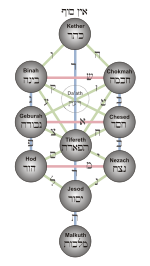
The 10 Sephirot, arranged into the 3 columns, with the 22 Paths of Connection of three types
[edit] Associations of the 3 columns
The Sephiroth are organized into three discrete columns or gimel kavim ("three lines" in Hebrew). They are often referred to as the three "Fathers," are derived from the three "Mothers," and are attributed to the vowels (Vav, Yud, and Heh.) They are as follows:
Kether heads the central column of the tree, which is known metaphorically speaking as the "Pillar of Mildness" and is associated with Hebrew letter Aleph, "the breath", and the air element. It is a neutral one, a balance between the two opposing forces of male and female tendencies. Some teachings describe the Sephirot on the centre pillar as gender-neutral, while others say that the Sephirot vary in their sexual attributions.
- Right column, in Hebrew kav yamin:
Chokhmah heads the right column of the tree, metaphorically speaking the "Pillar of Mercy", associated with the Hebrew letter Shin, the fire element, and the male aspect;
- Left column, in Hebrew kav smol:
The left column is headed by Binah and is called the "Pillar of Severity." It is associated with Hebrew letter Mem, the water element and the female aspect.
While the pillars are each given a sexual attribution, this does not mean that every sephirah on a given pillar has the same sexual attribution as the pillar on which they sit. In Jewish Kabbalah, of all the Sephirot only Binah and Malkuth are considered female, while all the other Sephirot are male.[citation needed]
Additionally (and this applies to both Jewish and Hermetic Kabbalah), each sephirah is seen as male in relation to the following sephirah in succession on the tree, and female in relation to the foregoing sephirah.
Alternative traditions consider the grammatical genders of the words involved. Thus, Gevurah is feminine because it has an atonal finial Heh. Thus, Severity or Justice becomes a feminine attribute while Chesed (Mercy or Lovingkindness) becomes a masculine one, despite the modern Western tendency to genderize these terms in reverse manner.
[edit] Numerological meanings
In a numerological sense, the Tree of Sephirot also has significance. Between the 10 Sephirot run 22 channels or paths which connect them, a number which can be associated with the 22 letters of the Hebrew alphabet. Together the spiritual forces of the 10 Sephirot and the 22 connecting channels are called the "32 Paths of Wisdom".
To envision the tree, consider each of these ten spheres as being concentric circles with Malkuth being the innermost and all others encompassed by the latter. None of these are separate from the other, and all simply help to form a more complete view of the perfected whole. To speak simply, Malkuth is the Kingdom which is the physical world upon which we live and exist, while Kether, also call Kaether and Kaether Elyon is the Crown of this universe, representing the highest attainable understanding of God that men can understand.
[edit] Rabbinic significance
As to the actual significance of the numbers 10 and 22 in context of Judaism goes into Kabbalistic interpretation of Genesis. God is said to have created the world through Ten Utterances, marked by the number of times Genesis states, “And God said.”
- Gen 1:3 - "And Elohim said, 'Let there be Light.' and there was Light." (Kether)
- Gen 1:6 - "And Elohim said, 'Let there be a firmament in the midst of the Waters, and let it divide the Waters from the Waters." (Chockmah)
- Gen 1:9 - "And Elohim said, 'Let the Waters under the heaven be gathered together unto one place, and let the dry land appear.' And it was so." (Binah)
- Gen 1:11 - "And Elohim said, 'Let the Earth bring forth grass, the herb yielding seed, and the fruit tree yielding fruit after his kind, whose seed is in itself, upon the earth.' And it was so." (Chesed)
- Gen 1:14-15 - "And Elohim said, 'Let there be lights in the firmament of the heaven to divide the day from the night; and let them be for signs, and for seasons, and for days, and years: And let them be for lights in the firmament of the heaven to give light upon the earth.' And it was so." (Gevurah)
- Gen 1:20 - "And Elohim said, 'Let the waters bring forth abundantly the moving creature that hath life, and fowl that may fly above the earth in the open firmament of heaven.'" (Tiphareth)
- Gen 1:22 - "And Elohim Blessed them, saying, 'Be fruitful, and multiply, and fill the waters in the seas, and let fowl multiply in the earth.'" (Netzach)
- Gen 1:26 - "And Elohim said, 'Let us make Man in our image, after our likeness: and let them have dominion over the fish of the sea, and over the fowl of the air,and over the cattle, and over all the earth, and over every creeping thing that creepeth upon the earth.'" (Hod)
- Gen 1:28 - "And Elohim blessed them and Elohim said to them, 'Be fruitful, and multiply, and replenish the earth, and subdue it: and have dominion over the fish of the sea, and over the fowl of the air, and over every living thing that moveth upon the earth.'" (Yesod)
- Gen 1:29-30 - "And Elohim said, 'Behold, I have given you every herb bearing seed, which is upon the face of all the earth, and every tree, in the which is the fruit of a tree yielding seed; to you it shall be for meat. And to every beast of the earth, and to every fowl of the air, and to every thing that creepeth upon the earth, wherein there is life, I have given every green herb for meat.' And it was so." (Malkuth)
As for the 22 letter-paths, there must first be an explanation of the three different types of letters in Hebrew. See “Bahir Tree” of “Kircher Tree” image for reference.
- There are three “Mothers” (Aleph, Mem, and Shin) that represent the horizontal lines.
- Their difference from the other letters is a matter for another article.
- There are seven “Doubles” (Bet, Gimel, Dalet, Kaf, Peh, Resh, and Tav) that represent the vertical lines.
- Each double is attributed to a soft and hard sound, positive and negative meaning, direction, planet, gate of the soul, color, angels, and vowel.
- Gimel, Dalet, Resh, and Tav’s second pronunciations are lost or disputed, with different dialects using different sounds. Tav has no second pronunciation in Sephardi, but Ashkenazi use a 's' sound when the dagesh is absent.
- The twelve “Elementals” (Heh, Vav, Zayin, Chet, Tet, Yud, Lamed, Nun, Samech, Ayin, Tzaddi, and Qof) have one pronunciation, and represent the diagonal lines. Other sources say that they correspond to the twelve zodiacal constellations.
Each letter grouping has significance in Genesis 1:
- The Mothers represent the three times Genesis states “God made."
- The Doubles represent the seven times Genesis states “God saw."
- The elementals (or singles) represent the rest of the times “God” (Elohim in every instance of Genesis Chapter 1) is mentioned.
- ^ Scholem, Kabbalah, p. 100, cited on Kabbalah page, note 14.
- ^ The Song of the Soul, Yechiel Bar-Lev, p. 73, cited on Kabbalah page, note 16.
- ^ See the discourse "On the Essence of Chassidus", Kehot Publication Society, described on the Hasidic philosophy page. The acronym "RADLA" for this level is identified as the origin of the Torah of Hasidus.
- ^ See for example the classic passage from the Zohar beginning "Elijah opened his discourse.." that is read every Friday afternoon to prepare for the Sabbath, in the Habad Siddur "Tehillat HaShem".
- ^ Mystical Concepts in Chassidism by Jacob Immanuel Schochet. Kehot Publications. Chapter on the Sephirot. Available separately, or printed at back of Bilinguel Hebrew-English edition Tanya
- ^ Mystical Concepts in Chassidism by Jacob Immanuel Schochet. Kehot Publications. Chapter on Sephirot. Available separately or printed at back of bilinguel Hebrew-English Tanya
- ^ Overview of Chassidut from www.inner.org. Retrieved Nov. 2009
- ^ The Ten Sefirot-Introduction from www.inner.org. Retrieved Nov. 2009
- ^ [http://www.inner.org/glossary/gloss_s.htm#Soul "Sefirah" in Glossary of Kabbalah and Chassidut] at www.inner.org. Retrieved Nov. 2009
- ^ The Powers of the Soul explained at www.inner.org. Retrieved Nov. 2009
[edit] References
- The Sefer Yetzirah the book of creation: In theory and practice, translated and explained by Aryeh Kaplan (1997). Samuel Weiser, Inc. (ISBN 0-87728-855-0)
- The Bahir, translated by Aryeh Kaplan (1995). Aronson. (ISBN 1-56821-383-2)
- Qabalistic Concepts: Living the Tree, William G Gray (1997). Samuel Weiser, Inc. (ISBN 1-57863-000-2)
- The Mystical Qabalah, Dion Fortune (Originally published: London, Williams & Norgate 1935; Revised edition published in 2000 by Red Wheel/Weiser, LLC) (ISBN 1-57863-150-5)
- On The Kabbalah and its Symbolism, Gershom Scholem (1996). Schocken. (ISBN 0-8052-1051-2)
- The Secret Teaching of All Ages by Manly P. Hall (October 27, 2003). Tarcher. ISBN 1-58542-250-9
- The Decad of Creation by Aaron Leitch (Journal of the Western Mystery Tradition, http://www.jwmt.org/v2n13/doc.html)
[edit] External links


.svg)
