Blogia

petalofucsia

HISTORIA11: PANACEAS (MEDICINE). The panacea (pronounced /pænəˈsiːə/), named after the Greek goddess of healing, Panacea, also known as panchrest, was supposed to be a remedy that would cure all diseases and prolong life indefinitely. It was sought by the alchemists as a connection to the elixir of life and the philosopher's stone, a mythical substance which would enable the transmutation of common metals into gold.

Panacea (medicine)

From Wikipedia, the free encyclopedia
Jump to: navigation, search

The panacea (pronounced /pænəˈsiːə/), named after the Greek goddess of healing, Panacea, also known as panchrest, was supposed to be a remedy that would cure all diseases and prolong life indefinitely. It was sought by the alchemists as a connection to the elixir of life and the philosopher's stone, a mythical substance which would enable the transmutation of common metals into gold.

A panacea is also a literary term to represent any solution to solve all problems related to a particular issue.

Compare: patent medicine, snake oil


HISTORIA11: ELIXIR. An elixir (Arabic: الإكسير, Al-Ikseer‎ probably originally Greek: ξήριον, medical powder, xerion "powder for drying wounds", from ξηρός, xeros dry[1] [1]) is a clear, sweet-flavored liquid (usually containing alcohol) used in compounding medicines to be taken orally in order to mask an unpleasant taste and intended to cure one's ills. Elixirs are sometimes made from vodka or grappa.

Elixir

From Wikipedia, the free encyclopedia
Jump to: navigation, search
Vodka can be used for making elixirs

An elixir (Arabic: الإكسير, Al-Ikseer‎ probably originally Greek: ξήριον, medical powder, xerion "powder for drying wounds", from ξηρός, xeros dry[1] [1]) is a clear, sweet-flavored liquid (usually containing alcohol) used in compounding medicines to be taken orally in order to mask an unpleasant taste and intended to cure one's ills. Elixirs are sometimes made from vodka or grappa.

When used as a pharmaceutical preparation, it contains at least one active ingredient dissolved in a solution that contains 15 to 50% by volume of ethyl alcohol and it is designed to be taken orally.

Contents

[hide]

[edit] Types

[edit] Non medicated elixirs

It is used as a solvent or vehicle for the preparation of medicated elixirs: aromatic elixirs (USP), isoalcholic elixirs (NF) or compound benaldehyde elixirs (NF).

[edit] Medicated elixirs
  • Antihistaminic elixirs: used against allergy: chlarphenivamine maleate elixirs (USP), diphenhydramine HCl elixirs.
  • Sedative and hypotonic elixirs: sedatives induce drowsiness and hypotonics induce sleep: pediatric chloral hydrate elixirs.
  • Expectorant: used as productive cough (cough with sputum): terpin hydrate elixirs.
  • Miscellaneous: acetaminophen (paracetamol) elixirs which are used as analgesic.

[edit] Composition

An elixir is a hydro-alcoholic solution of at least one active ingredient. The alcohol is mainly used to:

  • Solubilize the active ingredient(s) and some excipients
  • Retard the crystallization of sugar
  • Preserve the finished product
  • Provide a certain sharpness to the taste
  • Aid in masking the unpleasant taste of the active ingredient(s)
  • Enhance the flavor.

The lowest alcoholic quantity that will dissolve completely the active ingredient(s) and give a clear solution is generally chosen. High concentrations of alcohol give burning taste to the final product.

An elixir may also contain the following excipients:

[edit] Preparation

When preparing an elixir, it is important to pay attention to the solubility and the solubility strength of each ingredient. Here is an example of a method to prepare an elixir:

  • Dissolve water-soluble ingredients in a part of water
  • Add and solubilize sugar in this aqueous solution (sugar decreases the solubilizing properties of water)
  • Dissolve alcohol-soluble ingredients in alcohol
  • Add the aqueous phase to the alcoholic phase
  • Add clarifying agents like talc if needed
  • Filter if needed
  • Make to volume with water.

[edit] Storage

Elixirs should be stored in a tightly closed and light resistant container away from direct heat and sunlight.

[edit] See also

[edit] References

  1. ^ http://www.etymonline.com/index.php?term=elixir

HISTORIA11: PÓCIMAS O POCIONES MÁGICAS. A potion (from Greek poton "that which one drinks") is a consumable medicine or poison. In mythology and literature, a potion is usually made by a magician, sorcerer, dragon, fairy or witch and has magical properties. It might be used to heal, bewitch or poison people. For example, love potions make a person fall in love (or become deeply infatuated) with another (the love potion figures tragically into most versions of the tale of Tristan and Iseult, including Richard Wagner's opera Tristan und Isolde); sleeping potions cause a person to fall asleep (in folklore, this can range from normal sleep to a deathlike trance); and elixirs heal/cure any wound/malady (as in C.S. Lewis' The Lion, the Witch, and the Wardrobe). Goscinny and Uderzo's character Asterix the Gaul gained superhuman strength from a magic potion brewed by the druid Getafix.

Potion

From Wikipedia, the free encyclopedia
Jump to: navigation, search
"The Love Potion" by Evelyn de Morgan.

A potion (from Greek poton "that which one drinks") is a consumable medicine or poison.

In mythology and literature, a potion is usually made by a magician, sorcerer, dragon, fairy or witch and has magical properties. It might be used to heal, bewitch or poison people. For example, love potions make a person fall in love (or become deeply infatuated) with another (the love potion figures tragically into most versions of the tale of Tristan and Iseult, including Richard Wagner's opera Tristan und Isolde); sleeping potions cause a person to fall asleep (in folklore, this can range from normal sleep to a deathlike trance); and elixirs heal/cure any wound/malady (as in C.S. Lewis' The Lion, the Witch, and the Wardrobe). Goscinny and Uderzo's character Asterix the Gaul gained superhuman strength from a magic potion brewed by the druid Getafix.

Creation of potions of different kinds was a common practice of alchemy, and was commonly associated with witchcraft, as in Macbeth.

During the 19th Century, it was common in certain countries to see wandering charlatans offering curative potions. These eventually gained reputations as quack medicines. In later years, these transformed into patent medicines.

Illustration by Arthur Rackham to Richard Wagner's Siegfried: While Siegfried reforges the sword Nothung, Mime prepares a sleeping potion to use on him.

In modern fantasy, potions are often portrayed as spells in liquid form, capable of causing a variety of effects, including healing, amnesia, infatuation, transformation, invisibility, and invulnerability.[1] Potions have also gained popularity as a standard item in computer role playing games, usually as a healing item. The availability of healing potions in the popular Final Fantasy series of games eventually resulted in the release of an actual beverage named "Potion" in Japan by Square Enix, the games' creators.

[edit] See also

[edit] References

  1. ^ John Grant and John Clute, The Encyclopedia of Fantasy, "Potions", p 779 ISBN 0-312-19869-8

[edit] External links

HISTORIA11: ¿SIENTEN LOS MAGOS UN LIGERO DESEO DE IMPRESIONAR, UN PUNTO DE DESEAR IMPRESIONAR PERO MUY SUAVE, AUNQUE DESEO?EN CIERTO PUNTO INTELECTUAL, ¿DE REVISAR LO QUE SE SABE PARA LOGRARLO?. El término Mago proviene del persa antiguo maguš por mediación del griego μάγος y finalmente del latín magus. El sentido original de la palabra Mago se refería a los integrantes de una tribu de Media y luego a los sacerdotes persas. En términos modernos se refiere, a una especie de astrólogo o adivino, que practica magia o hechicería o brujería. Comúnmente, "Mago" se refiere a hechicero masculino, y "Bruja" a una hechicera.

Mago

De Wikipedia, la enciclopedia libre

El término Mago proviene del persa antiguo maguš por mediación del griego μάγος y finalmente del latín magus. El sentido original de la palabra Mago se refería a los integrantes de una tribu de Media y luego a los sacerdotes persas. En términos modernos se refiere, a una especie de astrólogo o adivino, que practica magia o hechicería o brujería. Comúnmente, "Mago" se refiere a hechicero masculino, y "Bruja" a una hechicera.

Contenido

[ocultar]

[editar] Historia

Originalmente, un magie era el miembro de una tribu de la antigua Media que se ocupaba de las prácticas religiosas y funerarias. Después de la conversión de esta tribu al zoroastrismo fueron considerados por los tres imperios persas, guardianes del legado de Zaratustra (a pesar de que introdujeron algunas modificaciones al mensaje original). Los magos de Persia fueron incluyendo en su religión algunos temas o elementos de Babilonia, como la astrología, la demonología y la magia. En su rito religioso vertían libaciones de leche, aceite y miel sobre una llama y al mismo tiempo entonaban rezos y canciones. Llevaban vestiduras blancas, tiara, y en la mano un haz de ramas de tamarisco.

Ya en el siglo I fueron reconocidos como hombres sabios y adivinos. Los más tarde llamados reyes magos, personajes llegados de Oriente y mencionados en la Biblia (Mateo 2,1-12) eran magos en el sentido original del término, esto es, sacerdotes persas.

El cambio de significado del término, que pasa a designar a alguien que practica la magia o hechicería, se debe a la asimilación que la Iglesia hizo de las creencias y rituales religiosos no cristianos (como los zoroastrianos) con la brujería y prácticas similares.

En un sentido muy diferente, en épocas recientes el título de "Mago" se ha asignado a los artistas que practican el ilusionismo, es decir a quienes realizan juegos para crear ilusiones visuales o en cualquiera de los sentidos, simulando poderes especiales, con objetivos recreativos. Esta "magia" ha entrado a formar parte de las artes escénicas contemporáneas.

En la actualidad el arte de la magia y la ilusión es utilizado por los magos para lograr el asombro y la diversión de sus espectadores.

[editar] Magos en la literatura moderna

En la literatura fantástica (sobre todo en la fantasía épica) aparecen muchas veces los magos como personas (incluyendo también no solo a humanos sino también a otras razas como los elfos) capaces de realizar cualquier cosa con su don.

  • El Señor de los Anillos: los únicos magos que aparecen son Gandalf, Radagast y Saruman, también conocidos como Istari, otros dos Istari mencionados en Cuentos inconclusos son Alatar y Pallando. Los orígenes de ambos magos se explican en El Silmarillion. Mientras que Gandalf es un sabio benévolo, Saruman se dejó influir por las fuerzas del mal al poseer en la Torre de Orthanc un palantir con el que espiaba los actos de Sauron. Al final se une a las fuerzas del mal, convirtiendo Isengard en una fortaleza bajo el dominio de los orcos. Saruman fue el principal enemigo de los ents y tras su derrota huyó al norte a la Comarca, donde después de que finalizase la Guerra del Anillo y se produjese el saneamiento de la comarca fue abatido por la flecha de un hobbit. Mientras tanto, Gandalf (conocido como el Gris) acompaña a la compañía del Anillo, pero cae en el abismo cuando lucha contra un demonio Balrog en el puente de Khazad-Dum. Más tarde resurge como Gandalf el blanco y se reencuentra con Aragorn, Gimli y Legolas en el Bosque de Fangorn.
  • Reinos olvidados: en este mundo de fantasía existe una gigantesca variedad de magos o hechiceros. Están principalmente los Magos Rojos de Thay, que utilizaban la magia para obtener más poder. Además de los magos humanos, otras razas tenían el poder de la magia, tales como los elfos, los drow e incluso algunas razas de enanos. El mago más famoso y poderosos de todos fue Elminster del Valle de las Sombras, quien tuvo un importante papel durante la cinjuración del Mythal. Además de los magos, en los Reinos también se encuentran los Druidas (quienes tiene la habilidad de transformarse en un animal), chamanes (principalmente de las razas bárbaras), brujos, nigromantes, etc. La magia en el mundo de los Reinos era transmitida por un dios de la magia que poseía el panteón de cada raza. Así por ejemplo, se encontraba Mystra, la diosa humana de la magia. Durante la época conocida como Era de los Trastornos, al ser todos los dioses expulsados del Olimpo (el lugar donde se encuentran), la magia se encontró terriblemente alterada.
  • Dragonlance: en esta saga de fantasía épica los magos se dividen en tres dependiendo del color de su túnica: los túnica blanca (los magos benignos), los túnica roja (los magos neutrales), y los túnica negra (los magos malignos). En un principio, los magos aprendían a dominar su arte y a estudiarlo en las Torres de la Alta Hechicería. En un principio había cinco, pero después del Cataclismo quedaron solo dos, ya que una de ellas quedó maldita y las otras dos fueron destruidas y asediadas por orden del Príncipe de los Sacerdotes. Destaca sobre todo el mago Raistlin Majere, quién tiene como consecuencia de una terrible prueba en una de las torres de la Alta Hechicería la piel amarillenta, las pupilas de los ojos con forma de reloj de arena y un terrible ataque de tos. Los magos fueorn los creadores de unos objetos llamados Orbes de los Dragones, capaces de controlar la mente de los poderosos dragones.
  • Harry Potter: En esta saga los magos pueden tener una vida mágica pero también una vida muggle, término comúnmente usado para denominar a las personas sin magia. Al principio los magos jóvenes tienen que ir al colegio para instruirse en el uso adecuado de la magia. En el libro, un joven llamado Harry Potter va al colegio y aprende sobre la magia y el mundo mágico mientras se enfrenta a los diversos ataques de su enemigo y antagonista de la historia, Lord Voldemort. Al pasar el tiempo Harry se va convirtiendo en un mago con grandes habilidades y con sus dos amigos Hermione Granger y Ron Weasley realiza un viaje para encontrar los horrocruxes que guardan pedazos del alma de Voldemort y así poder acabar con él.
  • En el 'universo de la DC Comics' existe una especie humana llamada los homo magi que tienen poderes mágicos por naturaleza, a esta especie pertenece la heroína Zatanna.

[editar] Véase también

[editar] Enlaces externos

CIENCIA3: FUERZA. En física, la fuerza es una magnitud física que mide la intensidad del intercambio de momento lineal entre dos partículas o sistemas de partículas (en lenguaje de la física de partículas se habla de interacción). Según una definición clásica, fuerza es toda causa agente capaz de modificar la cantidad de movimiento o la forma de los cuerpos materiales. No debe confundirse con los conceptos de esfuerzo o de energía. En el Sistema Internacional de Unidades, la fuerza se mide en newtons (N).

Fuerza

De Wikipedia, la enciclopedia libre
Para otros usos de este término, véase Fuerza (desambiguación).
Descomposición de las fuerzas que actúan sobre un sólido situado en un plano inclinado.

En física, la fuerza es una magnitud física que mide la intensidad del intercambio de momento lineal entre dos partículas o sistemas de partículas (en lenguaje de la física de partículas se habla de interacción). Según una definición clásica, fuerza es toda causa agente capaz de modificar la cantidad de movimiento o la forma de los cuerpos materiales. No debe confundirse con los conceptos de esfuerzo o de energía.

En el Sistema Internacional de Unidades, la fuerza se mide en newtons (N).

Contenido

[ocultar]

[editar] Introducción

La fuerza es una modelización matemática de intensidad de las interacciones, junto con la energía. Así por ejemplo la fuerza gravitacional es el jalón que se dan los cuerpos que tienen masa, el peso es el jalón que la tierra da a los objetos en las cercanias de su superficie, la fuerza elastica son los empujones o jalones que ejerce un resorte comprimido o estirado respectivamente, etc. En física hay dos tipos de ecuaciones de fuerza: las ecuaciones "causales" donde se especifica el origen del jalón o empujon: por ejemplo la ley de la gravitación universal de Newton o la ley de Coulomb y las ecuaciones de los efectos (la cual es fundamentalmente la segunda ley de Newton).

La fuerza es una magnitud física de carácter vectorial capaz de deformar los cuerpos (efecto estático), modificar su velocidad o vencer su inercia y ponerlos en movimiento si estaban inmóviles (efecto dinámico). En este sentido la fuerza puede definirse como toda acción o influencia capaz de modificar el estado de movimiento o de reposo de un cuerpo (imprimiéndole una aceleración que modifica el módulo o la dirección de su velocidad) o bien de deformarlo.

Comúnmente nos referimos a la fuerza aplicada sobre un objeto sin tener en cuenta al otro objeto u objetos con los que está interactuando y que experimentarán, a su vez, otras fuerzas. Actualmente, cabe definir la fuerza como un ente físico-matemático, de carácter vectorial, asociado con la interacción del cuerpo con otros cuerpos que constituyen su entorno.

[editar] Historia

Busto de Arquímedes.

El concepto de fuerza fue descrito originalmente por Arquímedes, si bien únicamente en términos estáticos. Arquímedes y otros creyeron que el "estado natural" de los objetos materiales en la esfera terrestre era el reposo y que los cuerpos tendían, por sí mismos, hacia ese estado si no se actuaba sobre ellos en modo alguno. De acuerdo con Aristóteles la perseverancia del movimiento requería siempre una causa eficiente (algo que parece concordar con la experiencia cotidiana, donde las fuerzas de fricción pueden pasar desapercibidas).

Galileo Galilei (1564 - 1642) sería el primero en dar una definición dinámica de fuerza, opuesta a la de Arquímedes, estableciendo claramente la ley de la inercia, afirmando que un cuerpo sobre el que no actúa ninguna fuerza permanece en movimiento inalterado. Esta ley, que refuta la tesis de Arquímedes, aún hoy día no resulta obvia para la mayoría de las personas sin formación científica

Se considera que fue Isaac Newton el primero que formuló matemáticamente la moderna definición de fuerza, aunque también usó el término latino vis ('fuerza') para otros conceptos diferentes. Además, Isaac Newton postuló que las fuerzas gravitatorias variaban según la ley de la inversa del cuadrado de la distancia.

Charles Coulomb fue el primero que comprobó que la interacción entre cargas eléctricas o electrónicas puntuales. variaba también según la ley de la inversa del cuadrado de la distancia (1784).

En 1798, Henry Cavendish logró medir experimentalmente la fuerza de atracción gravitatoria entre dos masas pequeñas utilizando una balanza de torsión. Gracias a lo cual pudo determinar el valor de la constante de la gravitación universal y, por tanto, pudo calcular la masa de la Tierra.

Con el desarrollo de la electrodinámica cuántica, a mediados del siglo XX, se constató que la "fuerza" era una magnitud puramente macroscópica surgida de la conservación del momento lineal o cantidad de movimiento para partículas elementales. Por esa razón las llamadas fuerzas fundamentales suelen denominarse "interacciones fundamentales".

[editar] Fuerza en mecánica newtoniana

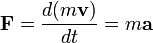
En mecánica newtoniana la fuerza se puede definir tanto a partir de la aceleración y la masa, como a partir de la derivada temporal del momento lineal, ya que para velocidades pequeñas comparadas con la luz ambas definiciones coinciden:

mathbf{F} = frac{d(mmathbf{v})}{dt} = mmathbf{a}

En el caso de la estática, donde no existen aceleraciones, las fuerzas actuantes pueden deducirse de consideraciones de equilibrio.

[editar] Fuerza gravitatoria

Fuerzas gravitatorias entre dos partículas.

En mecánica newtoniana la fuerza de atracción entre dos masas, cuyos centros de gravedad están lejos comparadas con las dimensiones del cuerpo,[1] viene dada por la ley de la gravitación universal de Newton:

 mathbf{F}_{21} =  -Gfrac{m_1m_2}{|mathbf{r}_{21}|^2}mathbf{e}_{21} = -Gfrac{m_1m_2}{|mathbf{r}_{21}|^3}mathbf{r}_{21}

Donde:

mathbf{F}_{21} es la fuerza que actúa sobre el cuerpo 2, ejercida por el cuerpo 1.G, constante de la gravitación universal.mathbf{r}_{21}=mathbf r_2 -mathbf r_1 vector de posición relativo del cuerpo 2 respecto al cuerpo 1.mathbf{e}_{21} es el versor dirigido hacía 2 desde 1.m_1, m_2, masas de los cuerpos 1 y 2.

Cuando la masa de uno de los cuerpos es muy grande en comparación con la del otro (por ejemplo, si tiene dimensiones planetarias), la expresión anterior se transforma en otra más simple:

 mathbf{F} =  -mleft(Gfrac{M}{R_0^2}right) hat{mathbf{u}}_r = -mghat{mathbf{u}}_r =  mmathbf{g}

Donde:

mathbf{F} es la fuerza del cuerpo de gran masa ("planeta") sobre el cuerpo pequeño.mathbf{u}_r es un versor cuya dirigido desde el centro del "planeta" al del cuerpo de pequeña masa.R_0, es la distancia entre el centro del "planeta" y el del cuerpo pequeño..

[editar] Fuerzas internas y de contacto

FN representa la fuerza normal ejercida por el plano inclinado sobre el objeto situado sobre él.

En los sólidos, el principio de exclusión de Pauli conduce junto con la conservación de la energía a que los átomos tengan sus electrones distribuidos en capas y tengan impenetrabilidad a pesar de estar vacíos en un 99%. La impenetrabildad se deriva de que los átomos sean "extensos" por el principio de Pauli y que los electrones de las capas exteriores ejerzan fuerzas electrostáticas de repulsión que hacen que la materia sea macroscópicamente impenetrable. Lo anterior se traduce en que dos cuerpos puestos en "contacto" experimentarán superficialmente fuerzas resultantes normales (o aproximadamente normales) a la superficie que impedirán el solapamiento de las nubes electrónicas de ambos cuerpos.

Las fuerzas internas son similares a las fuerzas de contacto entre ambos cuerpos y si bien tienen una forma más complicada, ya que no existe una superficie macroscópica a través de la cual se den la superficie. La complicación se traduce por ejemplo en que las fuerzas internas necesitan ser modelizadas mediante un tensor de tensiones en que la fuerza por unidad de superficie que experimenta un punto del interior depende de la dirección a lo largo de la cual se consideren las fuerzas.

Lo anterior se refiere a sólidos, en los fluidos en reposo las fuerzas internas dependen esencialmente de la presión, y en los fluidos en movimiento la viscosidad puede desempeñar un papel

[editar] Fricción

Artículo principal: Fricción

La fricción puede darse entre las superficies libres de sólidos, en el tratamiento de los problemas mediante mecánica newtoniana la fricción entre sólidos frecuentemente se modeliza como una fuerza sobre el plano tangente del contacto entre sólidos, de valor porporcional a la fuerza normal.

El rozamiento entre sólido líquido y en el interior de un líquido o un gas depende esencialmente de si el flujo se considera laminar o turbulento, de la ecuación constitutiva.

[editar] Fuerzas de campos estacionarios

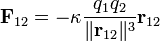
En mecánica newtoniana también es posible modelizar algunas fuerzas constantes en el tiempo como campos de fuerza. Por ejemplo la fuerza entre dos cargas eléctricas inmóviles, puede representarse adecuadamente mediante la ley de Coulomb:

mathbf{F}_{12} = -kappafrac{q_1q_2}{|mathbf{r}_{12}|^3}mathbf{r}_{12}

Donde:

mathbf{F}_{12} es la fuerza ejercida por la carga 1 sobre la carga 2.kappa, una constante que dependerá del sistema de unidades para la carga.mathbf{r}_{12} vector de posición de la carga 2 respecto a la carga 1.q_1, q_2, valor de las cargas.

También los campos magnéticos estáticos y los debidos a cargas estáticas con distribuciones más complejas pueden resumirse en dos funciones vectoriales llamadas campo eléctrico y campo magnético tales que una partícula en movimiento respecto a las fuentes estáticas de dichos campos viene dada por la expresión de Lorentz:

mathbf{F} = q (mathbf{E} + mathbf{v} times mathbf{B}),

Donde:

mathbf{E} es el campo eléctrico.mathbf{B} es el campo magnético.mathbf{v} es la velocidad de la partícula.q, es la carga total de la partícula.

Los campos de fuerzas no constantes sin embargo presentan una dificultad especialmente cuando están creados por partículas en movimiento rápido, porque en esos casos los efectos relativistas de retardo pueden ser importantes, y la mecánica clásica, da lugar a un tratamiento de acción a distancia que puede resultar inadecuado si las fuerzas cambian rápidamente con el tiempo.

[editar] Unidades de fuerza

En el Sistema Internacional de Unidades (SI) y en el Cegesimal (cgs), el hecho de definir la fuerza a partir de la masa y la aceleración (magnitud en la que intervienen longitud y tiempo), conlleva a que la fuerza sea una magnitud derivada. Por en contrario, en el Sistema Técnico la fuerza es una Unidad Fundamental y a partir de ella se define la unidad de masa en este sistema, la unidad técnica de masa, abreviada u.t.m. (no tiene símbolo). Este hecho atiende a las evidencias que posee la física actual, expresado en el concepto de Fuerzas Fundamentales, y se ve reflejado en el Sistema Internacional de Unidades.

Equivalencias

1 newton = 100 000 dinas1 kilogramo-fuerza = 9,806 65 newtons1 libra fuerza ≡ 4,448 222 newtons

[editar] Fuerza en mecánica relativista

En relatividad especial la fuerza se debe definir sólo como derivada del momento lineal, ya que en este caso la fuerza no resulta simplemente proporcional a la aceleración:

mathbf{F} = frac{d}{dt}left( frac{mmathbf{v}}{sqrt{1-frac{v^2}{c^2}}}right) = frac{mmathbf{v}}{left[1-frac{v^2}{c^2}right]^{3/2}} left( frac{mathbf{v}}{c^2}cdot mathbf{a} right) + frac{mmathbf{a}}{sqrt{1-frac{v^2}{c^2}}}

De hecho en general el vector de aceleración y el de fuerza ni siquiera serán paralelos, sólo en el movmieno movimiento circular uniforme y en cualquier movimiento rectilíneo serán paralelos el vector de fuerza y aceleración pero en general se el módulo de la fuerza dependerá tanto de la velocidad como de la aceleración.

[editar] "Fuerza" gravitatoria

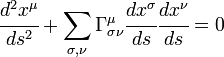
En la teoría de la relatividad general el campo gravitatorio no se trata como un campo de fuerzas real, sino como un efecto de la curvatura del espacio-tiempo. Una partícula másica que no sufre el efecto de ninguna otra interacción que la gravitatoria seguirá una trayectoria geodésica de mínima curvatura a través del espacio-tiempo, y por tanto su ecuación de movimiento será:

cfrac{d^2 x^mu}{ds^2} + sum_{sigma,nu} Gamma_{sigma nu}^{mu} cfrac{dx^sigma}{ds}cfrac{dx^nu}{ds} = 0

Donde:

x^mu, son las coordenadas de posición de la partícula.s, el parámetro de arco, que es proporcional al tiempo propio de la partícula.Gamma_{sigmanu}^mu, son los símbolos de Christoffel correspondientes a la métrica del espacio-tiempo.

La fuerza gravitatoria aparente procede del término asociado a los símbolos de Christoffel. Un observador en "caída libre" formará un sistema de referencia en movimiento en el que dichos símbolos de Christoffel son nulos, y por tanto no percibirá ninguna fuerza gravitatoria tal como sostiene el principio de equivalencia que ayudó a Einstein a formular sus ideas sobre el campo gravitatorio.

[editar] Fuerza electromagnética

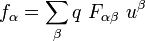
El efecto del campo electromagnético sobre una partícula relativista viene dado por la expresión covariante de la fuerza de Lorentz:

f_{alpha} = sum_{beta} q  F_{alpha beta}  u^{beta} ,

Donde:

f_alpha, son las componentes covariantes de la cuadrifuerza experimentada por la partícula.F_{alphabeta}, son las componentes del tensor de campo electromagnético.u^alpha, son las componentes de la cuadrivelocidad de la partícula.

La ecuación de movimiento de una partícula en un espacio-tiempo curvo y sometida a la acción de la fuerza anterior viene dada por:

mfrac{Du^mu}{Dtau} = mleft (cfrac{d^2 x^mu}{dtau^2} + Gamma_{sigma nu}^{mu} cfrac{dx^sigma}{dtau}cfrac{dx^nu}{dtau} right) = f^mu

Donde la expresión anterior se ha aplicado el convenio de sumación de Einstein para índices repetidos, el miembro de la derecha representa la cuadriaceleración y siendo las otras magnitudes:

f^mu = g^{mualpha}f_alpha, son las componentes contravarianetes de la cuadrifuerza electromagnética sobre la partícula.m, es la masa de la partícula.

[editar] Fuerza en física cuántica

[editar] Fuerza en mecánica cuántica

En mecánica cuántica no resulta fácil definir para muchos sistemas un equivalente claro de la fuerza. Esto sucede porque en mecánica cuántica un sistema mecánico queda descrito por una función de onda o vector de estado scriptstyle |psi rangle que en general representa a todo el sistema en conjunto y no puede separarse en partes. Sólo para sistemas donde el estado del sistema pueda descomponerse de manera no ambigua en la forma scriptstyle |psi rangle = |psi_A rangle + |psi_B rangle donde cada una de esas dos partes representa una parte del sistema es posible definir el concepto de fuerza. Sin embargo en la mayoría de sistemas interesanes no es posible esta descomposición. Por ejemplo si consideramos el conjunto de electrones de un átomo, que es un conjunto de partículas idénticas no es posible determinar una mangitud que represente la fuerza entre dos electrones concretos, porque no es posible escribir una función de onda que describa por separado los dos electrones.

Sin embargo, en el caso de una partícula aislada sometida a la acción de una fuerza conservativa es posible describir la fuerza mediante un potencial externo e introducir la noción de fuerza. Esta situación es la que se da por ejemplo en el modelo atómico de Schrödinger para un átomo hidrogenoide donde el electrón y el núcleo son discernibles uno de otro. En éste y otros casos de una partícula aislada en un potencial el teorema de Ehrenfest lleva a una generalización de la segunda ley de Newton en la forma:

 frac{d}{dt}langle prangle = int Phi^* V(mathbf{x},t)nablaPhi~d^3mathbf{x} - int Phi^* (nabla V(mathbf{x},t))Phi ~d^3mathbf{x} - int Phi^* V(mathbf{x},t)nablaPhi~d^3mathbf{x}  = 0 - int Phi^* (nabla V(mathbf{x},t))Phi ~d^3mathbf{x} - 0 = langle -nabla V(mathbf{x},t)rangle = langle F rangle,

Donde:

<p>, es el valor esperado del momento lineal de la partícula.Phi(mathbf{x}), Phi^*(mathbf{x}) es la función de onda de la partícula y su compleja conjugada.V(mathbf{x},t), es el potencial del que derivar las "fuerzas".nabla, denota el operador nabla.

En otros casos como los experimentos de colisión o dispersión de partículas elementales de energía positiva que son disparados contra otras partículas que hacen de blanco, como los experimentos típicos llevados a cabo en aceleradores de partículas a veces es posible definir un potencial que está relacionado con la fuerza típica que experimentará una partícula en colisión, pero aún así en muchos casos no puede hablarse de fuerza en el sentido clásico de la palabra.

[editar] Fuerzas fundamentales en teoría cuántica de campos

Artículo principal: Interacciones fundamentales
Cuadro explicativo de las 4 fuerzas fundamentales.

En teoría cuántica de campos, el término "fuerza" tiene un sentido ligeramente diferente al que tiene en mecánica clásica debido a la dificultad específica señalada en la sección anterior de definir un equivalente cuántico de las fuerzas clásicas. Por esa razón el término "fuerza fundamental" en teoría cuántica de campos se refiere al modo de interacción entre partículas o campos cuánticos, más que a una medida concreta de la interacción de dos partículas o campos.

La teoría cuántica de campos trata de dar una descripción de las formas de interacción existentes entre las diferentes formas de materia o campos cuánticos existentes en el Universo. Así el término "fuerzas fundamentales" se refiere actualmente a los modos claramente diferenciados de interacción que conocemos. Cada fuerza fundamental quedará descrita por una teoría diferente y postulará diferentes lagrangianos de interacción que describan como es ese modo peculiar de interacción.

Cuando se formuló la idea de fuerza fundamental se consideró que existían cuatro "fuerzas fundamentales": la gravitatoria, la electromagnética, la nuclear fuerte y la nuclear débil. La descripción de las "fuerzas fundamentales" tradicionales es la siguiente:

  1. La gravitatoria es la fuerza de atracción que una masa ejerce sobre otra, y afecta a todos los cuerpos. La gravedad es una fuerza muy débil y de un sólo sentido, pero de alcance infinito.
  2. La fuerza electromagnética afecta a los cuerpos eléctricamente cargados, y es la fuerza involucrada en las transformaciones físicas y químicas de átomos y moléculas. Es mucho más intensa que la fuerza gravitatoria, puede tener dos sentidos (atractivo y repulsivo) y su alcance es infinito.
  3. La fuerza o interacción nuclear fuerte es la que mantiene unidos los componentes de los núcleos atómicos, y actúa indistintamente entre dos nucleones cualesquiera, protones o neutrones. Su alcance es del orden de las dimensiones nucleares, pero es más intensa que la fuerza electromagnética.
  4. La fuerza o interacción nuclear débil es la responsable de la desintegración beta de los neutrones; los neutrinos son sensibles únicamente a este tipo de interacción (aparte de la gravitatoria,

electromagnética y su alcance es aún menor que el de la interacción nuclear fuerte. Sin embargo, cabe señalar que el número de fuerzas fundamentales en el sentido anteriormente expuesto depende de nuestro estado de conocimiento, así hasta finales de los años 1960 la interacción débil y la interacción electromagnética se consideraban fuerzas fundamentales diferentes, pero los avances teóricos permitieron establecer que en realidad ambos tipos de interacción eran manifestaciones fenomenológicamente diferentes de la misma "fuerza fundamental", la interacción electrodébil. Se tiene la sospecha de que en última instancia todas las "fuerzas fundamentales" son manifestaciones fenomenológicas de una única "fuerza" que sería descrita por algún tipo de teoría unificada o teoría del todo.

[editar] Véase también

[editar] Referencia

  1. Si esta condición no se cumple la expresión resultante es diferente debido a que las zonas más cercanas entre cuerpos tienen una influencia mayor que las zonas más alejadas

[editar] Bibliografía

[editar] Enlaces externos

HISTORIA11: LA KABBALAH Y LA LENGUA SEMÍTICA. Las lenguas semíticas son una familia de la macrofamilia de lenguas afroasiáticas. Se desarrollaron sobre todo por Oriente Próximo y el norte y este de África. Toman su nombre del personaje bíblico Sem, el hijo de Noé, cuyos descendientes serían en base a la historia bíblica y la tradición, los pueblos semitas. Las lenguas semíticas más habladas en el presente son el árabe, el amárico, el hebreo y el tigriña. La protolengua o grupo de dialectos estrechamente ligados que habría dado lugar a las lenguas semíticas se conoce como protosemítico.

Lenguas semíticas

De Wikipedia, la enciclopedia libre
Lenguas semíticas
Distribución geográfica:Norte de África, Medio Oriente y Etiopía
Países: 
Hablantes:350 millones
Puesto:{{{rank}}} (Ethnologue 1996)
Filiación genética:afroasiático

  afrosiático septentrional
    semítico

Subdivisiones:semítico oriental
semítico occidental
semítico meridional
Oficiales en{{{oficial}}}
ISO 639-1{{{iso1}}}
ISO 639-2sem
ISO 639-3{{{sil}}}
Distribución aproxiamda de las lenguas semíticas hacia principios de nuestra era.
Extensión
Véase también:
Idioma - Familias - Clasificación de lenguas

Las lenguas semíticas son una familia de la macrofamilia de lenguas afroasiáticas. Se desarrollaron sobre todo por Oriente Próximo y el norte y este de África. Toman su nombre del personaje bíblico Sem, el hijo de Noé, cuyos descendientes serían en base a la historia bíblica y la tradición, los pueblos semitas.

Las lenguas semíticas más habladas en el presente son el árabe, el amárico, el hebreo y el tigriña. La protolengua o grupo de dialectos estrechamente ligados que habría dado lugar a las lenguas semíticas se conoce como protosemítico.

Contenido

[ocultar]

[editar] Historia

De la familia semítica se conservan registros escritos ininterrumpidos desde el 2500 a. C. hasta el presente, lo que hace de ella la mejor testimoniada históricamente. Compárense los 4500 años de registros de lenguas semíticas con los algo más de 3500 años de textos en lenguas chinas, los 3400 años de textos griegos o los 3200 años que median entre las primeras inscripciones en egipcio antiguo y los últimos textos en copto). Los primeros textos semíticos conocidos están escritos en acadio (ca. 2500 a. C., - 1600 a. C.), eblaíta (ca. 2400 a. C.), ugarítico (ca. 1400 a. C. - ca. 1185 a. C.), lenguas cananeas (ca. 1200 a. C.), hebreo antiguo (ca. 1100 a. C.- 250 d. C.), fenicio-púnico (ca. 1000 a. C. - 200 d. C.) y arameo antiguo (900 a. C. - 250 d. C.).

[editar] Clasificación

Las lenguas semíticas suelen dividirse en tres grandes grupos: orientales (Mesopotamia), occidentales o nordoccidentales (Oriente Próximo) y meridionales o sudoccidentales (Península Arábiga y Cuerno de África).

[editar] Lenguas semíticas orientales

Todas las lenguas semíticas del grupo oriental están actualmente extinguidas. A esta rama pertenece la lengua semítica más antigua conocida, el acadio, que se hablaba en zonas del actual Iraq. Las más antiguas inscripciones en acadio datan de la primera mitad del tercer milenio antes de Cristo, y utilizan la escritura cuneiforme, tomada de los sumerios. Hacia el 2000 a. C., el acadio se fragmentó en dos lenguas diferentes: el babilonio, hablado en el sur de Mesopotamia, y el asirio, hablado en el norte.

Se discute si el eblaíta, lengua hablada en la ciudad de Ebla, en Siria, en el tercer milenio antes de nuestra era, recientemente descubierta, pertenece a este grupo o al de las lenguas occidentales, puesto que parece tener similitudes con ambas ramas.

[editar] Lenguas semíticas occidentales (o nordoccidentales)

La mayor parte de estas lenguas están también extinguidas. Sobreviven únicamente dos: el hebreo y el arameo.

Las lenguas semíticas occidentales conocidas son:

  • Amorrita: se conoce únicamente a través de nombres propios no acadios transmitidos por escribas acadios durante la época de dominio amorrita en Mesopotamia, en el segundo milenio antes de nuestra era.
  • Lenguas cananeas: principalmente, fenicio, púnico, moabita, edomita, hebreo y ammonita. Hay indicios de que el fenicio se hablaba y escribía a mediados del segundo milenio antes de nuestra era, aunque sólo existen inscripciones en esa lengua a partir del año 1000 a. C., extendidas por todo el Mediterráneo oriental. Del fenicio derivó el púnico, la lengua de los cartagineses, que aún era hablada en el siglo V, según el testimonio de San Agustín. Las lenguas moabita, edomita y ammonita se hablaron en el área en torno al Jordán; de estas lenguas existen sólo unas pocas inscripciones de la primera mitad del primer milenio antes de nuestra era.
El caso del hebreo es bastante peculiar. La primera inscripción conocida en esta lengua data del año 925 a. C., y muchos de los libros de la Biblia están escritos en dicha lengua. Sin embargo, a partir del siglo IV a. C. sufre la dura competencia del arameo. Se extinguió finalmente en el siglo II, sobreviviendo sólo como lengua litúrgica. Fue recuperado con esfuerzo a partir del siglo XIX por los sionistas, que necesitaban una lingua franca para los inmigrantes judíos en Palestina, procedentes de todos los rincones del mundo, y es hoy la lengua oficial del estado de Israel, con unos seis millones de hablantes.
  • Arameo: documentado desde el 850 a. C., en Siria, se extendió rápidamente por todo Oriente Próximo, llegando a convertirse en la lingua franca de un extensísimo territorio que se extendía desde Afganistán hasta Egipto. Siguió siendo, en competencia con el griego, el idioma más importante de Oriente Próximo hasta que, tras el advenimiento del islam, fue desplazado por el árabe. Estuvo dividido en varios dialectos, clasificados en dos grandes grupos: arameo occidental y arameo oriental. Uno de los dialectos más destacados, perteneciente al grupo oriental, es el siríaco, lengua litúrgica de varias iglesias cristianas orientales.
El arameo subsiste en la actualidad. Se estima que hay unos 400.000 hablantes de esta lengua, la mayor parte de ellos en el área de Oriente Próximo.

[editar] Lenguas semíticas meridionales (o sudoccidentales)

El grupo de lenguas semíticas meridionales incluye las lenguas sudarábigas, el árabe y las lenguas etiópicas.

[editar] Lenguas sudarábigas

  • Lenguas sudarábigas modernas: Relacionadas con estas lenguas epigráficas, existen lenguas sudarábigas modernas en algunas zonas de los actuales Yemen y Omán, y en la isla de Socotra. Son seis lenguas: mehri, harsusi, bathari, hobyot, jibbali y soqotri. Esta última, hablada en Socotra, es la que tiene un número más elevado de hablantes (unos 50.000).

[editar] La lengua árabe

El árabe es, con mucho, la lengua semítica más hablada. Se calcula que tiene alrededor de 250 millones de hablantes. Los primeros textos conocidos en árabe datan del siglo IV. La rápida expansión del islam a partir del siglo VII llevó aparejada la difusión de la lengua árabe por una zona muy extensa, que va desde la costa atlántica de África hasta Mesopotamia. Con el tiempo, la lengua se fue fragmentando en dialectos locales, si bien el árabe clásico se mantuvo como lengua escrita y, en la actualidad, se emplea en los medios de comunicación de masas. Los diferentes dialectos vernáculos (Iraq, Siria, Líbano, Egipto, Magreb) que constituyen el árabe difieren bastante del árabe clásico -tanto como el italiano del latín, se ha dicho-, y, en muchos casos, no son inteligibles entre sí.

[editar] Las lenguas etiópicas

Las lenguas etiópicas se dividen en etiópicas septentrionales y etiópicas meridionales.

  • Etiópicas septentrionales: ge'ez, tigriña y tigré. El ge'ez, la lengua del antiguo Reino de Aksum, se extinguió como lengua hablada hace varios siglos, pero sigue existiendo como lengua litúrgica de la Iglesia Ortodoxa Etíope. La lengua tigré es hablada en la actualidad por 0,8 millones de personas, mayoritariamente musulmanas, en Eritrea, a lo largo de la costa del Mar Rojo. El tigriña, por último, es la cuarta lengua semítica con mayor número de hablantes (unos 5 millones), repartidos fundamentalmente entre el norte de Etiopía y Eritrea. De este último estado es una de las tres lenguas oficiales.
  • Etiópicas meridionales: a este grupo pertenecen varias lenguas, como el kistane (250.000 hablantes), el argobba (40.000), el harari (20.000), las lenguas silte (800.000), entre otras muchas. Por encima de todas destaca el amárico, la segunda lengua semítica más hablada después del árabe con unos 17 millones de hablantes, y lengua oficial de Etiopía.

[editar] Características comunes

Artículo principal: Protosemítico

[editar] Fonología

Las lenguas semíticas evolucionaron de una lengua, el protosemítico, que tenía tres vocales breves y tres vocales largas. Gran parte de las lenguas semíticas poseen fricativas faringales y oclusiva glotal. Además la mayoría en el sistema de consonantes suele existir una oposición tripartita: sorda, sonora y "enfática" (donde la realización de esta última varía entre la faringalización, la velarización o la coarticulación glotal).

[editar] Morfología

Los lexemas de las palabras suelen estar constituidos por esqueletos consonánticos, teniendo el esquema vocálico entre las consonantes información gramatical. Entre las raíces consonánticas o lexemas la gran mayoría son de tres consonantes. Tienen un sistema de infijos muy desarrollado (los patrones vocálicos son una forma de infijación de hecho).

HISTORIA11: SEPHIROT. VER TAMBIÉN "KABÓR" QUE SIGNIFICA ORÍGEN EN LENGUA SEMITA. Sephirot (In Hebrew סְפִירוֹת, pronunciation), meaning "enumerations", are the 10 attributes/emanations in Kabbalah, through which God (who is referred to as Ein Sof - The Infinite) reveals himself and continuously creates both the physical realm and the chain of higher metaphysical realms (Seder hishtalshelus). The term is alternatively transliterated into English as Sephiroth/Sefiroth, singular Sephirah etc.

Sephirot

From Wikipedia, the free encyclopedia
Jump to: navigation, search
For other uses of Sephirot or Sephira, see Sephirot (disambiguation)
The Sefirot in Jewish Kabbalah
KeterBinahChokhmahDa'atGevurahChesedTiferetHodNetzachYesodMalkuthThe Sefirot in Jewish Kabbalah
View the image description page for the diagram
Category:Sephiroth

Sephirot (In Hebrew סְפִירוֹת, pronunciation), meaning "enumerations", are the 10 attributes/emanations in Kabbalah, through which God (who is referred to as Ein Sof - The Infinite) reveals himself and continuously creates both the physical realm and the chain of higher metaphysical realms (Seder hishtalshelus). The term is alternatively transliterated into English as Sephiroth/Sefiroth, singular Sephirah etc.

Alternative configurations of the sephirot are given by different schools in the historical development of Kabbalah, with each articulating different spiritual aspects. The tradition of enumerating 10 is stated in the Sefer Yetzirah, "Ten sephirot of nothingness, ten and not nine, ten and not eleven". As altogether 11 sephirot are listed across the different schemes, two (Keter and Daat) are seen as unconscious and conscious manifestations of the same principle, conserving the ten categories. In Kabbalah the functional structure of the sephirot in channelling Divine creative lifeforce, and revealing the unknowable Divine essence to Creation is described. As God's attributes to allow Creation to know him, the first sephirah describes the Divine Will above intellect. The next sephirot describe conscious Divine Intellect, and the latter sephirot describe the primary and secondary conscious Divine Emotions. Two sephirot (Binah and Malchut) are feminine, as the female principle in Kabbalah describes a vessel that receives the outward male light, then inwardly nurtures and gives birth to lower sephirot. Corresponding to this is the Female Divine Presence (Shechinah). Kabbalah sees the human soul as mirroring the Divine (after Genesis 1:27, "God created man in His own image, in the image of God He created him, male and female He created them"), and more widely, all creations as reflections of their lifesource in the sephirot. Therefore, the sephirot also describe the spiritual life of man, and constitute the conceptual paradigm in Kabbalah for understanding everything. This relationship between the soul of man and the Divine, gives Kabbalah one of its two central metaphors in describing Divinity, alongside the other Ohr (light) metaphor. However, Kabbalah repeatedly stresses the need to avoid all corporeal interpretation. Through this, the sephirot are related to the structure of the body and are reformed into Partsufim (Personas). Underlying the structural purpose of each sephirah is a hidden motivational force which is understood best by comparison with a corresponding psychological state in human spiritual experience. In Hasidic philosophy, which has sought to internalise the experience of Jewish mysticism into daily inspiration (dveikus), this inner life of the sephirot is explored, and the role they play in man's service of God in this world.

Contents

[hide]

[edit] Ten Sephirot

The "Sefirot" (סְפִירוֹת), singular "Sefirah" (סְפִירָה), literally means "counting"/"enumeration", but early Kabbalists presented a number of other etymological possibilities from the same Hebrew root including: sefer (text), sippur (recounting a story), sappir (sapphire, brilliance, luminary), separ (boundary), and safra (scribe). The term sefirah thus has complex connotations within Kabbalah.[1]

The Sephirot are considered revelations of the Creator's Will ("ratzon"),[2] and they should not be understood as ten different "gods" but as ten different ways the one God reveals his Will through the Emanations. While in Cordoveran Kabbalah, Keter (The Divine Will) is listed as the first Sephirah, it is an intermediary above consciousness between God and the other, conscious Sephirot. The Sephirot are emanated from the Divine Will, because Kabbalah sees different levels within Keter, reflecting God's inner Will and outer Will. The innermost, hidden levels of Keter, also in some contexts called "The head/beginning that is not known",[3] are united above the Sephirot with the Ein Sof (Divine essence). It is not God who changes but the ability to perceive God that changes. This difference between the "Ma'Ohr" ("Luminary"-Divine essence) and the "Ohr" ("Light") He emanates is stressed in Kabbalah, so as to avoid heretical notions of any plurality in the Godhead. In its early 12th-century dissemination, Kabbalah received criticism from some Rabbis, who adhered to "Hakirah" (Medieval Jewish philosophy), for its alleged introduction of multiplicity into Jewish monotheism. The multiplicity of revealed emanations only applies from the persective of the Creation, and not from the perspective of the infinite Divine essence.[4]

[edit] Listings

The ten Sephirot are a step-by-step process illuminating the Divine plan as it unfolds itself in Creation. They are fully found in the Medieval Kabbalah texts, such as the central work in Kabbalah, the Zohar. The Hebrew etymology of their names in Kabbalah is understood to refer to the nuanced aspects of meaning of each Sephirah. This direct connection between spiritual and physical creations and their Hebrew names, reflects the theology in Kabbalah that Creation is formed from the metaphorical speech of God, as in the first chapter of Genesis. Kabbalah expounds on the terms of the Sephirot. In the first complete systemisation of Kabbalah, in the 16th-century rational synthesis of Moshe Cordovero (Cordoveran Kabbalah), the Sephirot are listed from highest to lowest:[5]

Category:Sephirah:
Above-consciousness1 Keter-"Crown"
Conscious intellect2 Chokhmah-"Wisdom"

3 Binah-"Understanding"

Conscious emotions(Primary emotions:)

4 Chesed-"Kindness"
5 Gevurah-"Severity"
6 Tiferet-"Beauty"
(Secondary emotions:)
7 Netzach-"Eternity"
8 Hod-"Splendor"
9 Yesod-"Foundation"
(Vessel to bring action:)
10 Malkuth-"Kingship"

In the subsequent 16th-century transcendent Kabbalistic scheme of Isaac Luria (Lurianic Kabbalah), the Sephirot are usually listed slightly differently, by taking out Keter and adding in Daat, as Daat is seen as the conscious manifestation of the unconscious Keter. This difference of opinion reflects earlier Medieval debate on whether Keter can be identified with the Ohr Ein Sof (Infinite light) itself, or as the first revealed Sephirah. Isaac Luria includes Keter in the list only in relation to the inner light of the Sephirot. In his usual list of the Sephirot as formed attributes (vessels), Keter is considered too lofty to include:[6]

Category:Sephirah:
Conscious intellect1 Chokhmah-"Wisdom"

2 Binah-"Understanding"
3 Daat-"Knowledge"

Conscious emotions(Primary emotions:)

4 Chesed-"Kindness"
5 Gevurah-"Severity"
6 Tiferet-"Beauty"
(Secondary emotions:)
7 Netzach-"Eternity"
8 Hod-"Glory"
9 Yesod-"Foundation"
(Vessel to bring action:)
10 Malkuth-"Kingship"

[edit] Description

  • Keter-"Crown": Divine Will to create/Infinite Light of the Creator/the Hebrew name of God "Ehyeh Asher Ehyeh-I am That I am"
  • Chochmah-"Wisdom": First unbounded flash of an idea before it takes on limitations/male light/Divine Reality/first revelation/creation from nothingness
  • Binah-"Understanding": the infinite flash of Chochmah brought into the vessel of understanding to give it grasp of breadth and depth/feminine vessel that gives birth to the emotions/reason/understanding brings teshuva return to God
  • Daat is a central state of unity of the 10 Sephirot, also called the Tree of Life.
  • Chesed-"Kindness": Loving grace of free giving/love of God/inspiring vision
  • Gevurah-"Severity": Strength/judgment/intention/withholding/awe of God
  • Tiferet-"Beauty": Symmetry/balance between Chesed and Gevurah in compassion
  • Netzach-"Eternity"
  • Hod-"Glory": Withdrawal/Surrender/sincerity
  • Yesod-"Foundation": Connecting to the task to accomplish/wholly remembering/coherent knowledge
  • Malchut-"Kingship": Female vessel for the pregnant nurturing of the male lights of the emotional sephirot into action/becomes the Keter Will source for any subsequent lower level in Creation/accomplishment/realization of the Divine Plan.

[edit] Two configurations for describing the Sephirot: Iggulim-Circles and Yosher-Upright

Two alternative spiritual arrangements for describing the Sephirot are given, metaphorically described as "Circles" and "Upright". Their origins come from Medieval Kabbalah and the Zohar. In later, 16th-century Lurianic kabbalah, they become systemised as two successive stages in the evolution of the Sephirot, during the primordial cosmic evolution of Creation. This evolution is central to the metaphysical process of tikkun (fixing) in the doctrines of Issac Luria.

[edit] Iggulim-Circles
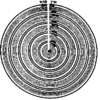
Metaphorical representation of the Five Worlds, with the 10 Sephirot radiating in each, as successively smaller Iggulim-concentric circles

One diagramatic representation depicts the Sephirot metaphorically as successively smaller concentric circles, radiating inwards from the surrounding Divine Omnipresence. The Four Worlds of the Seder hishtalshelus ("Chain of Progression"), or with the addition of the highest Fifth World (Adam Kadmon), can be depicted in this diagram, starting with the highest and proceeding towards the centre of the circle to our lowest, physical realm. In each World the 10 Sephirot radiate, as 10 successive steps in the downward chain of flow towards the next, lower realm. This depiction shows the successive nature of each of the 10 Sephirot, as a downward chain, each more removed from Divine consciousness.

The surrounding space in the diagram is the Infinite Divine reality (Ein Sof). The outermost circle in the teachings of Lurianic kabbalah is the "space" made by the Tzimtzum in which Creation unfolds. Each successive World is progressively further removed from Divine revelation, a metaphorically smaller, more costricted circle. Emanation in each World proceeds down the 10 Sephirot, with the last Sephirah (Malchut-Actualisation of the Divine plan) of one World becoming, and being shared as, the first Sephirah (Keter-The Divine Will) of the next, lower realm. The vertical line into the centre of the circle represents the path of downward emanation and constriction, from the initial first Ohr (light) of the "Kav" (Ray) in Lurianic doctrine.

[edit] Yosher-Upright and the Man-metaphor in Kabbalah
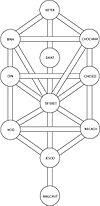
The Yosher-Upright configuration of the 10 Sephirot, arranged into 3 columns

The most important and well known scheme of depicting the Sephirot arranges them as a tree with 3 columns. The Right column represents the spiritual force of expansion. The Left represents its opposite, restriction. The Middle column is the balance and synthesis between these opposing tendencies. The connecting lines in the diagram show the specific connections of spiritual flow between the Sephirot, the "22 Connecting Paths", and corresponding to the spiritual channels of the 22 letters of the Hebrew alphabet. Kabbalah sees the Hebrew letters as channels of spiritual lifeforce. This derives from the account in Genesis of the Creation of the World, where Creation takes place through 10 Hebrew "Sayings" of God ("Let there be.."). In Kabbalistic theology, these letters remain the immanent spiritual forces that constantly recreate all existence. The paths divide into 3 Categories, shown in this diagram by their different colours, corresponding to the 3 types of letter.

[edit] Evolution of the Sephirot in Lurianic kabbalah from Iggulim to Yosher

Lurianic Kabbalah described radical new doctrines of the cosmic origins of Creation. It taught that the first Divine act was a "withdrawal" ("Tzimtzum") from the "space" ("Chalal") in which Creation would unfold. This is understood by all interpretations today to be a metaphorical withdrawal, only from the persective of the Creation. A diminished "Ray" ("Kav") of new light then shone from the Ein Sof into the Chalal, which became the source of "light" (Ohr) that created all existence.

However, Isaac Luria taught that the first created spiritual "World/Realm" ("Olam") collapsed. This realm, the "World of Tohu" ("Chaos", mirroring the phrase at the beginning of Genesis), failed because the 10 Sephirot in it had very high lights and weak vessels (see Ohr for description of the lights and vessels of the Sephirot). The vessels broke ("Shevirat HaKeilim"-"The Shattering of the Vessels") and their "Sparks" ("Nitzutzot") fell down into our Four Worlds. The four realms of our cosmic existence are together called the "World of Tikkun" ("Fixing"-see Tikkun). Lurianic Kabbalah explains that the reason for the catastrophe was because the 10 Sephirot in the World of Tohu remained separate points of spiritual force. Chesed (Loving-kindness) remained Chesed. Gevurah (Severity) remained its opposite force of restriction, and the Sephirot did not unite together. In the new cosmic existence of Tikkun, the Sephirot evolve into new paradigmatic arrangements, where they can unite together. The different realms (see Seder Hishtalshelut) of the World of Tikkun are characterised as lower lights and stronger vessels.

[edit] Latent interinclusion of the Sephirot

The first development that enabled the Sephirot to unite in cooperation was the interinclusion within each of them of a further subset of the 10 Sephirot. So, for example, Chesed contains Chesed within Chesed, Gevurah within Chesed (typified by a restriction performed out of love, like a father punishing a child) etc. In Kabbalistic interpretation, as there are 7 emotional Sephirot, their subsets form 7x7=49 emotional states. This gives the Kabbalistic interpretation of the mitzvah (Jewish observance) of Counting of the Omer, to count the 49 days of personal spiritual development between the festivals of Passover and Shavuot. Passover commemorates the exodus from Egypt, and in Jewish mystical thought, Egypt (in Hebrew "Mitzrayim", meaning "Limitations") represents the challenges to leave behind in spiritual development. In Kabbalah and Hasidism, leaving Egypt becomes a daily spiritual exodus, especially in the 49 days of preparation to reach Shavuot, commemorating receiving the Torah on Biblical Mount Sinai. Kabbalah teaches the benefit of focusing on the aspect of each Sephirah related to the particular day of the Omer. A person would examine each of their spiritual qualitities, as a rectification process of Teshuva (Return to God)), in preparation to reliving the acceptance of the Torah.

Day of Counting the Omer:Sub-divided Sephirah:
First day of Passover
Exodus from Egypt
 
1Chesed of Chesed
2Gevurah of Chesed
3Tiferet of Chesed
etc. 
47Hod of Malchut
48Yesod of Malchut
49Malchut of Malchut
Festival of Shavuot
Receiving of Torah at Sinai

[edit] Reconfiguration of the Sephirot as full Partsufim-Personas

Subsequent to the interinclusion of the 10 Sephirot within each other, in Lurianic Kabbalah they then develop into "Partsufim" ("Personas"). Wide discussion of the Partsufim is found in the Medieval Kabbalah of the Zohar, before Issac Luria. In the Zohar, Shimon bar Yochai expounds upon the spiritual roles of the Parsufim, by talking about them as independent spiritual manifestations. "The Holy Ancient of Days", or "The Long Visage", two of the different Parsufim, are not just alternative adjectives for God, but are particular spiritual manifestations, levels and natures. Lurianic Kabbalah focused on the role of the Parsufim as the fully evolved stage of the primordial evolution of the Sephirot, in the beginning of Creation. Instead of each of the 10 Sephirot merely including a full subset of 10 Sephirot as latent potential forces, the first stage of their evolution, in the Parsufim the Sephirot become fully autonomous and interrelated. The name of each Partsuf denotes that the Sephirah from which it derived, has now become an independent scheme of 10 fully functioning Sephirot in the "Upright" (Yosher) form of "Man". This reconfiguration is essential in Lurianic Kabbalah to enable the opposing spiritual forces of the Sephirot to work together in harmony. Each Parsuf now operates independently, and unites with the other Parsufim. So, for example, "The Long Visage" is said to descend, and become enclothed within the lower Parsufim. The Sephirot now harmonise, to enable the Lurianic scheme of Tikkun (Rectification) to begin. The names of the fundamental Parsufim and their English translations:

Sephirah:
Original Sephirah before evolution
Partsuf:
Developed full "Persona" form
Above conscious Crown:
Keter
Inner Keter: Atik Yomin
"Ancient of Days"

Outer Keter: Arich Anpin
"Long Face/Visage"
(Macroprosopus)
Intellectual Wisdom:
Chochma
Abba
"Father"
Intellectual Understanding:
Binah
Imma
"Mother"
6 Emotional Sephirot:
Chesed
Gevurah
Tiferet
Netzach
Hod
Yesod
Zeir Anpin
"Small Face/Visage"
(Microprosopus)
Male son
Last Emotional Sephirah:
Malchut
Nukva
"Feminine"
Counterpart of Zeir Anpin
Feminine daughter

[edit] Inner dimensions of the Sephirot and the Powers of the Soul

As all levels of Creation are constructed around the 10 Sephirot, their names in Kabbalah describe the particular role each plays in forming reality. These are the external dimensions of the Sephirot, describing their functional roles in channelling the Divine, creative Ohr (Light) to all levels. As the Sephirot are viewed to comprise both metaphorical "lights" and "vessels", their structural role describes the particular identity each Sephirah possesses from its characteristic vessel. Underlying this functional structure of the Sephirot, each one possesses a hidden, inner spiritual motivation that inspires its activity. This forms the particular characteristic of inner light within each Sephirah.

Understanding the Sephirot throughout Jewish mysticism is achieved by their correspondence to the soul of man. This applies to the outer, Kabbalistic structure of the Sephirot. It applies even more to their inner dimensions, which correspond to inner psychological qualities in the perception of man. Identifying the essential spiritual properties of the soul gives the best insight into their Divine source, and in the process reveals the spiritual beauty of the soul. In Hasidic philosophy these inner dimensions of the Sephirot are called the "Powers of the Soul". Hasidism sought the internalisation of the abstract ideas of Kabbalah, both outwardly in joyful sincerity of dveikus in daily life, acts of loving-kindness and prayer; and inwardly in its profound new articulation of Jewish mystical thought, by relating it to the inner life of man.[7] Articulation of the Sephirot in Hasidic philosophy is primarily concerned with their inner dimensions, and exploring the direct, enlivening contribution of each in man's spiritual worship of God.[8] Kabbalah focuses on the esoteric manifestations of God in Creation, the vessels of Divinity. Hasidut looks at the lights that fill these vessels, how the structures reveal the Divine essence, and how this inwardness can be perceived. This difference can be seen in the names of these two stages of Jewish mysticism. "Kabbalah" in Hebrew is derived from "kabal" (to "receive" as a vessel). "Hasidut" is from "chesed" ("lovingkindness"), considered the first and greatest Sephirah, also called "Greatness", the wish to reveal and share. The names of the Sephirot come from Kabbalah, and describe the Divine effect that each has upon Creation, but not their inner qualities. Hasidic thought uses new descriptive terms for the inner dimensions of the Sephirot:[9][10]

Sephirah:
Outer function in Divinity and soul
Inner experience:
Inner Divine motivation and human soul response
Above conscious:
Keter-Crown
Essence of Keter:
Emunah-"Faith"
(expresses essence of soul in Infinite)

Inner Keter:
Taanug-unconscious source of "Delight"
(soul rooted in delight)

Outer Keter:
Ratzon-unconscious transcendent "Will"
(soul expresses through will)
First revelation of intellect:
Chochma-Insight of Wisdom
Bittul-"Selflessness"
(Revelation inspires self nullification)
Grasped Intellect:
Binah-Understanding
Simchah-"Joy"
(Understanding awakens joy)
Assimilated Intellect:
Daat-Knowledge
Yichud-"Union"
(Union with idea awakens emotions)
Primary emotion of giving:
Chesed-Lovingkindness
Ahavah-"Love" of God and Divine in all things
(Response of Divine giving)
Primary emotion of restriction:
Gevurah-Might/Severity
Yirah-"Fear" of God
(Mystical awe of Divinity)
Primary emotion of balance:
Tiferet-Beautiful harmony
Rachamim-"Mercy/Compassion"
(Balances kindness with restriction)
Secondary emotion of giving:
Netzach-Victory/Eternity
Bitachon-"Confidence"
(Confidence inspires determination)
Secondary emotion of restriction:
Hod-Splendour/Thanksgiving
Temimut-"Sincerity/Earnestness"
(Sincere response to Divine Glory)
Secondary emotion of balance:
Yesod-Foundation
Emet-"Truth"
(True connection to fulfill task)
Emotional vessel for action:
Malchut-Kingship
Shiflut-"Lowliness"
(Action through receiving higher Sephirot lights)

[edit] The Sephirot and the Four Worlds

These ten levels are associated with Kabbalah's (Zohar) four different "Worlds" or planes of existence, the main part from our perspective of the descending "chain of progression" (Seder hishtalshelus), that links the Infinite Divine Ein Sof with our finite, physical realm. In all Worlds, the 10 Sephirot radiate, and are the Divine channels through which every level is continuously created from nothing. Since they are the attributes through which the unknowable, infinite Divine essence becomes revealed to the creations, all ten emanate in each World. Nonetheless, the structure of the Four Worlds arises because in each one, certain Sephirot predominate. Each World is spiritual, apart from the lower aspect of the final World, which is our "Asiyah Gashmi" ("Physical Asiyah"), our physical Universe. Each World is progressively grosser and further removed from consciousness of the Divine, until in our World it is possible to deny God. In descending order:

  1. Atzilut (אֲצִילוּת)-World of "Emanation": In this level the light of the Ein Sof radiates and is united with its source. Divine Chochma, the limitless flash of wisdom beyond grasp, predominates.
  2. Beriah (בְּרִיאָה)-World of "Creation": In this level, is the first creation ex nihilo, where the souls and angels have self awareness, but without form. Divine Binah, the intellectual understanding, predominates.
  3. Yetzirah (יְצִירָה)-World of "Formation": On this level, creation is related to form. The Divine emotional Sephirot of Chesed to Yesod predominate.
  4. Asiyah (עֲשִׂיָּה)-World of "Action": On this level creation is relegated to its physical aspect, the only physical realm and the lowest World, our realm with all its creatures. The Divine Kingship of Malchut predominates, the purpose of Creation.

In the Zohar and elsewhere, there are these four Worlds or planes of existence. In the Lurianic system of Kabbalah, five Worlds are counted, comprising these and a higher, fifth plane, Adam Kadmon-manifest Godhead level, that mediates between the Ein Sof and the four lower Worlds.

As the four Worlds link the Infinite with our realm, they also enable the soul to ascend in devotion or mystical states, towards the Divine. Each World can be understood as descriptive of dimensional levels of intentionality related to man's natural "desire to receive", and a method for the soul's progress upward toward unity with or return to the Creator. (The terminology of this formulation is based on the exposition of Lurianic Kabbalah by the 20th Century Kabbalist Yehuda Ashlag).

[edit] Scriptural, Numerological and Spiritual associations of the Sefirotic Tree
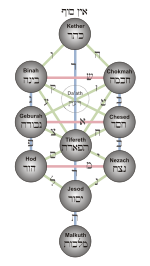
The 10 Sephirot, arranged into the 3 columns, with the 22 Paths of Connection of three types

[edit] Associations of the 3 columns

The Sephiroth are organized into three discrete columns or gimel kavim ("three lines" in Hebrew). They are often referred to as the three "Fathers," are derived from the three "Mothers," and are attributed to the vowels (Vav, Yud, and Heh.) They are as follows:

  • Central column:

Kether heads the central column of the tree, which is known metaphorically speaking as the "Pillar of Mildness" and is associated with Hebrew letter Aleph, "the breath", and the air element. It is a neutral one, a balance between the two opposing forces of male and female tendencies. Some teachings describe the Sephirot on the centre pillar as gender-neutral, while others say that the Sephirot vary in their sexual attributions.

  • Right column, in Hebrew kav yamin:

Chokhmah heads the right column of the tree, metaphorically speaking the "Pillar of Mercy", associated with the Hebrew letter Shin, the fire element, and the male aspect;

  • Left column, in Hebrew kav smol:

The left column is headed by Binah and is called the "Pillar of Severity." It is associated with Hebrew letter Mem, the water element and the female aspect.

While the pillars are each given a sexual attribution, this does not mean that every sephirah on a given pillar has the same sexual attribution as the pillar on which they sit. In Jewish Kabbalah, of all the Sephirot only Binah and Malkuth are considered female, while all the other Sephirot are male.[citation needed]

Additionally (and this applies to both Jewish and Hermetic Kabbalah), each sephirah is seen as male in relation to the following sephirah in succession on the tree, and female in relation to the foregoing sephirah.

Alternative traditions consider the grammatical genders of the words involved. Thus, Gevurah is feminine because it has an atonal finial Heh. Thus, Severity or Justice becomes a feminine attribute while Chesed (Mercy or Lovingkindness) becomes a masculine one, despite the modern Western tendency to genderize these terms in reverse manner.

[edit] Numerological meanings

In a numerological sense, the Tree of Sephirot also has significance. Between the 10 Sephirot run 22 channels or paths which connect them, a number which can be associated with the 22 letters of the Hebrew alphabet. Together the spiritual forces of the 10 Sephirot and the 22 connecting channels are called the "32 Paths of Wisdom".

To envision the tree, consider each of these ten spheres as being concentric circles with Malkuth being the innermost and all others encompassed by the latter. None of these are separate from the other, and all simply help to form a more complete view of the perfected whole. To speak simply, Malkuth is the Kingdom which is the physical world upon which we live and exist, while Kether, also call Kaether and Kaether Elyon is the Crown of this universe, representing the highest attainable understanding of God that men can understand.

[edit] Rabbinic significance

As to the actual significance of the numbers 10 and 22 in context of Judaism goes into Kabbalistic interpretation of Genesis. God is said to have created the world through Ten Utterances, marked by the number of times Genesis states, “And God said.”

  • Gen 1:3 - "And Elohim said, 'Let there be Light.' and there was Light." (Kether)
  • Gen 1:6 - "And Elohim said, 'Let there be a firmament in the midst of the Waters, and let it divide the Waters from the Waters." (Chockmah)
  • Gen 1:9 - "And Elohim said, 'Let the Waters under the heaven be gathered together unto one place, and let the dry land appear.' And it was so." (Binah)
  • Gen 1:11 - "And Elohim said, 'Let the Earth bring forth grass, the herb yielding seed, and the fruit tree yielding fruit after his kind, whose seed is in itself, upon the earth.' And it was so." (Chesed)
  • Gen 1:14-15 - "And Elohim said, 'Let there be lights in the firmament of the heaven to divide the day from the night; and let them be for signs, and for seasons, and for days, and years: And let them be for lights in the firmament of the heaven to give light upon the earth.' And it was so." (Gevurah)
  • Gen 1:20 - "And Elohim said, 'Let the waters bring forth abundantly the moving creature that hath life, and fowl that may fly above the earth in the open firmament of heaven.'" (Tiphareth)
  • Gen 1:22 - "And Elohim Blessed them, saying, 'Be fruitful, and multiply, and fill the waters in the seas, and let fowl multiply in the earth.'" (Netzach)
  • Gen 1:26 - "And Elohim said, 'Let us make Man in our image, after our likeness: and let them have dominion over the fish of the sea, and over the fowl of the air,and over the cattle, and over all the earth, and over every creeping thing that creepeth upon the earth.'" (Hod)
  • Gen 1:28 - "And Elohim blessed them and Elohim said to them, 'Be fruitful, and multiply, and replenish the earth, and subdue it: and have dominion over the fish of the sea, and over the fowl of the air, and over every living thing that moveth upon the earth.'" (Yesod)
  • Gen 1:29-30 - "And Elohim said, 'Behold, I have given you every herb bearing seed, which is upon the face of all the earth, and every tree, in the which is the fruit of a tree yielding seed; to you it shall be for meat. And to every beast of the earth, and to every fowl of the air, and to every thing that creepeth upon the earth, wherein there is life, I have given every green herb for meat.' And it was so." (Malkuth)

As for the 22 letter-paths, there must first be an explanation of the three different types of letters in Hebrew. See “Bahir Tree” of “Kircher Tree” image for reference.

  • There are three “Mothers” (Aleph, Mem, and Shin) that represent the horizontal lines.
    • Their difference from the other letters is a matter for another article.
  • There are seven “Doubles” (Bet, Gimel, Dalet, Kaf, Peh, Resh, and Tav) that represent the vertical lines.
    • Each double is attributed to a soft and hard sound, positive and negative meaning, direction, planet, gate of the soul, color, angels, and vowel.
    • Gimel, Dalet, Resh, and Tav’s second pronunciations are lost or disputed, with different dialects using different sounds. Tav has no second pronunciation in Sephardi, but Ashkenazi use a 's' sound when the dagesh is absent.
  • The twelve “Elementals” (Heh, Vav, Zayin, Chet, Tet, Yud, Lamed, Nun, Samech, Ayin, Tzaddi, and Qof) have one pronunciation, and represent the diagonal lines. Other sources say that they correspond to the twelve zodiacal constellations.

Each letter grouping has significance in Genesis 1:

  • The Mothers represent the three times Genesis states “God made."
  • The Doubles represent the seven times Genesis states “God saw."
  • The elementals (or singles) represent the rest of the times “God” (Elohim in every instance of Genesis Chapter 1) is mentioned.

[edit] Notes

  1. ^ Scholem, Kabbalah, p. 100, cited on Kabbalah page, note 14.
  2. ^ The Song of the Soul, Yechiel Bar-Lev, p. 73, cited on Kabbalah page, note 16.
  3. ^ See the discourse "On the Essence of Chassidus", Kehot Publication Society, described on the Hasidic philosophy page. The acronym "RADLA" for this level is identified as the origin of the Torah of Hasidus.
  4. ^ See for example the classic passage from the Zohar beginning "Elijah opened his discourse.." that is read every Friday afternoon to prepare for the Sabbath, in the Habad Siddur "Tehillat HaShem".
  5. ^ Mystical Concepts in Chassidism by Jacob Immanuel Schochet. Kehot Publications. Chapter on the Sephirot. Available separately, or printed at back of Bilinguel Hebrew-English edition Tanya
  6. ^ Mystical Concepts in Chassidism by Jacob Immanuel Schochet. Kehot Publications. Chapter on Sephirot. Available separately or printed at back of bilinguel Hebrew-English Tanya
  7. ^ Overview of Chassidut from www.inner.org. Retrieved Nov. 2009
  8. ^ The Ten Sefirot-Introduction from www.inner.org. Retrieved Nov. 2009
  9. ^ [http://www.inner.org/glossary/gloss_s.htm#Soul "Sefirah" in Glossary of Kabbalah and Chassidut] at www.inner.org. Retrieved Nov. 2009
  10. ^ The Powers of the Soul explained at www.inner.org. Retrieved Nov. 2009

[edit] References

[edit] External links

HISTORIA11: METAFÍSICA. ONTOLOGÍA (RELATIVO AL ENTE). En filosofía, la ontología (del griego οντος, genitivo del participio del verbo εἰμί, ser, estar; y λóγος, ciencia, estudio, teoría) es una parte de la metafísica que estudia lo que hay,[1] es decir cuáles entidades existen y cuáles no. Muchas preguntas tradicionales de la filosofía pueden ser entendidas como preguntas de ontología:[1] ¿existe un Dios? ¿Existen entidades mentales, como ideas y pensamientos? ¿Existen entidades abstractas, como los números? ¿Existen los universales?

Ontología

De Wikipedia, la enciclopedia libre
Este artículo trata sobre la rama de la filosofía. Para su uso en informática , véase Ontología (informática) .
El primer capítulo de B'reshit (el Génesis) escrito sobre un huevo, en el Museo de Jerusalén.

En filosofía, la ontología (del griego οντος, genitivo del participio del verbo εἰμί, ser, estar; y λóγος, ciencia, estudio, teoría) es una parte de la metafísica que estudia lo que hay,[1] es decir cuáles entidades existen y cuáles no. Muchas preguntas tradicionales de la filosofía pueden ser entendidas como preguntas de ontología:[1] ¿existe un Dios? ¿Existen entidades mentales, como ideas y pensamientos? ¿Existen entidades abstractas, como los números? ¿Existen los universales?

Además, la ontología estudia la manera en que se relacionan las entidades que existen.[1] Por ejemplo, la relación entre un universal (rojo) y un particular que "lo tiene" (esta manzana), o la relación entre un evento (Sócrates bebió la cicuta) y sus participantes (Sócrates y la cicuta).[1]

Contenido

[ocultar]

[editar] Introducción

Estudiantes de Aristóteles utilizaron el término metafísica por primera vez (literalmente quiere decir "después de la física") para referirse a lo que su maestro describió como "filosofía primera", posteriormente conocida como ontología. La ontología es la investigación del ser en tanto que ser, o del ser en general, más allá de cualquier cosa en particular que es o existe. Es también el estudio de los seres en la medida en que existen, y no en la medida en que hechos particulares obtienen de ellos o propiedades particulares para ellos. Tome cualquier cosa que pueda encontrar en el mundo, y obsérvelo, no como a una mascota o a una rebanada de pizza, una silla o a un presidente, sino simplemente como algo que es. Más específicamente, la ontología se encarga de determinar qué categorías del ser son fundamentales y se pregunta si a los objetos en esas categorías se les puede calificar de “seres”, y en qué sentido.

Algunos filósofos, sobre todo de la escuela de Platón, sostienen que todos los sustantivos se refieren a entidades existentes. Otros afirman que los sustantivos no siempre nombran entidades, sino que ofrecen una forma de referencia a una colección de objetos o sucesos. En este sentido, la mente, en lugar de referirse a una entidad, se refiere a una colección de sucesos mentales experimentados por una persona.

[editar] Historia del término

Al parecer el primero en usar la expresión “ontología" (aunque con caracteres griegos) en sentido filosófico fue Rodolfo Goclenio en obra Lexicon philosophicum, quo tanquam clave philosophiae fores aperiuntur en el año 1613. Se afirma allí que la ontología es la filosofía del ente.

Después de diversos usos y su paso a caracteres latinos, Leibniz usa la expresión en su Introductio ad Encyclopaediam arcanam y la define como “ciencia de lo que es y de la nada, del ente y del no ente, de las cosas y de sus modos, de la sustancia y del accidente”.

Ya como término técnico la encontramos en la obra Ontologia sive de ente in genere de Jean Le Clerc publicada en 1692. Y Christian Wolff la populariza definiéndola como “ciencia del ente en general, en cuanto que ente”. Afirma que usa un método demostrativo o deductivo y analiza los predicados que corresponden al ente en cuanto ente.

Todos estos sentidos contribuyeron a identificarla en la práctica con la metafísica.

[editar] El problema ontológico

El problema central de la ontología fue presentado muy elocuentemente por Willard van Orman Quine en su artículo Sobre lo que hay:[2]

Un rasgo curioso del problema ontológico es su simplicidad. Puede formularse en dos monosílabos castellanos: «¿Qué hay?». Puede además responderse en una sola palabra: «Todo», y todos aceptarán esta respuesta como verdadera. Sin embargo, esto es sólo decir que hay lo que hay. Queda lugar para discrepancias en casos particulares; y así la cuestión ha persistido a través de los siglos.[3]

En general, cada uno de estos "casos particulares" presenta un problema distinto.[4] Desde la segunda mitad del siglo XX, el naturalismo imperante ha determinado que los debates metafísicos sean principalmente acerca de la existencia o no de todo aquello que parece entrar en conflicto con la descripción del mundo provista por las teorías científicas más exitosas.[5] Esto se refleja en la elección de algunos de los casos que se mencionan a continuación:

  • Las entidades abstractas: Es ampliamente aceptado que todas las entidades caen en una de dos categorías: o son abstractas, o son concretas.[6] Los números, los conjuntos y los conceptos son algunos ejemplos de entidades que intuitivamente clasificamos como abstractas, mientras que el planeta Venus, este árbol y aquella persona son ejemplos intuitivos de entidades concretas. Sin embargo, todavía no existe un criterio aceptado para decidir cuándo una entidad es abstracta y cuándo concreta, aparte de la intuición. Además, tampoco existe acuerdo sobre si las entidades abstractas siquiera existen, y en caso de que existan, sobre cuáles existen.[7]
  • Las entidades del sentido común: Al encontrar una silla, ¿debemos decir que lo que hay en el mundo es una silla? ¿O sería más correcto decir que lo que hay, estrictamente hablando, es un montón de moléculas? ¿O quizás un montón de átomos?[8] Y está claro que este argumento puede extenderse a muchas otras entidades del sentido común.
  • Los universales: Los universales (también llamados propiedades, atributos o cualidades) son los supuestos referentes de los predicados como "verde", "áspero", "amigo" o "insecto".[9] La existencia de los universales se postula para justificar nuestra manera de hablar acerca de los individuos. Así por ejemplo, estamos justificados en decir de una planta que "es verde", porque la planta posee el universal verde, o alternativamente porque el universal verde esta presente en la planta. Además, podemos decir de varias cosas que "son todas verdes", porque el universal verde, siendo algo distinto de las cosas, está sin embargo presente en todas ellas. El problema de los universales es acerca de si los universales existen, y en caso de que así sea, cuál es su naturaleza: si existen en las cosas (in re), o independientemente de ellas (ante rem), o en nuestra mente, por mencionar algunas posturas.[10]
  • La mente y lo mental: Al abrir una cabeza, lo que vemos no es una mente, con pensamientos, ideas y recuerdos, sino materia. ¿Será que lo mental es una ilusión, y que todo lo que hoy describimos en términos mentales puede reducirse a los procesos físicos que observa la ciencia? ¿O será que lo mental es algo efectivamente existente, inmaterial e inobservable?[5] Para un poco más de discusión, véase El problema mente-cuerpo, abajo.
  • Los agujeros: A primera vista, los agujeros están "hechos de nada". ¿Como es posible, pues, referirnos a ellos como si fueran objetos comunes? ¿Cómo es posible percibirlos? ¿Qué percibimos?[11]

[editar] La ontología como disciplina diversa de la metafísica

Dada la acepción cada vez más restringida que la ontología iba tomando, dentro de la Neoescolástica quedó como una investigación de las propiedades llamadas Trascendentales. De ahí que Kant pueda afirmar –trasladando esta noción a su propia filosofía–, que la ontología es el estudio de los conceptos a priori que residen en el entendimiento y tienen su uso en la experiencia, llevando la noción hacia un sentido más inmanente.

[editar] Husserl

Según Husserl la ontología es una ciencia de las esencias que puede ser formal o material. La primera se dedica a las esencias formales, es decir, a las propiedades de todas las esencias. Las ontologías materiales tratan de esencias materiales y se restringen según los modos de sus objetos. Por tanto, son llamadas también “ontologías regionales”.[12] Obviamente la ontología formal abarca todas las materiales e incluso las del ser...

[editar] Heidegger

Heidegger afirma que existe una ontología fundamental que es llamada “metafísica de la existencia” que se encarga de descubrir “la constitución del ser de la existencia”. La ontología se refiere entonces a las condiciones de posibilidad de las existencias o al ser mismo en su apertura originaria.[13]

Además, insiste en diferenciar la metafísica de la ontología, alegando que son radicalmente distintas, pues la primera confunde ser con ente; mientras que la segunda, parte precisamente del hecho de que son diferentes.

[editar] Hartmann

Partiendo de una crítica de la noción de ontología como metafísica y con ella de toda la escolástica, Hartmann afirma que la ontología es en realidad la crítica que permite descubrir los límites de la metafísica y qué contenidos pueden ser considerados racionales o inteligibles.[14]

[editar] Notas y referencias

  1. a b c d Hofweber, Thomas, «Logic and Ontology», en Edward N. Zalta (en inglés), Stanford Encyclopedia of Philosophy (Spring 2009 Edition edición), http://plato.stanford.edu/archives/spr2009/entries/logic-ontology/ 
  2. W.v.O. Quine On what there is, Review of Metaphysics, September 1948, 2(5): 21-38
  3. From a logical point of view p. 1
  4. Fundamentos de ontología dialéctica p. 64
  5. a b Sosa, Ernest, «Problems of metaphysics» (en inglés), Oxford Companion to Philosophy, http://www.oxfordreference.com/views/ENTRY.html?subview=Main&entry=t116.e1588, consultado el 15 de julio de 2009 
  6. Rosen, Gideon, «Abstract Objects», en Edward N. Zalta (en inglés), The Stanford Encyclopedia of Philosophy (Summer 2009 Edition edición), http://plato.stanford.edu/archives/sum2009/entries/abstract-objects/ 
  7. Oliver, Alexander D., «abstract entities» (en inglés), The Oxford Companion to Philosophy, http://www.oxfordreference.com/views/ENTRY.html?subview=Main&entry=t116.e8, consultado el 20 de julio de 2009 
  8. Wittgenstein, Ludwig. Investigaciones filosóficas. §47. «¿Pero cuáles son las partes constituyentes simples de las que se compone la realidad?—¿Cuáles son las partes constituyentes simples de una silla?—¿Los trozos de madera con los que está ensamblada? ¿O las moléculas, o los átomos?» 
  9. Lowe, E. J., «universals» (en inglés), The Oxford Companion to Philosophy, http://www.oxfordreference.com/views/ENTRY.html?subview=Main&entry=t116.e2602, consultado el 19 de julio de 2009 
  10. Simon Blackburn, ed., «universals» (en inglés), Oxford Dictionary of Philosophy, http://www.oxfordreference.com/views/ENTRY.html?subview=Main&entry=t98.e3206, consultado el 20 de julio de 2009 
  11. Casati, Roberto, «Holes» (en inglés), Stanford Encyclopedia of Philosophy (Winter 2008 Edition edición), http://plato.stanford.edu/archives/win2008/entries/holes/ 
  12. E. HUSSERL, Ideen zu einer reinen Phänomenologie.
  13. M. HEIDEGGER, Was ist Metaphysik.
  14. N. HARTMANN, Ontología, 1954.

[editar] Véase también

[editar] Bibliografía adicional

[editar] Enlaces externos